How to Grow TVL
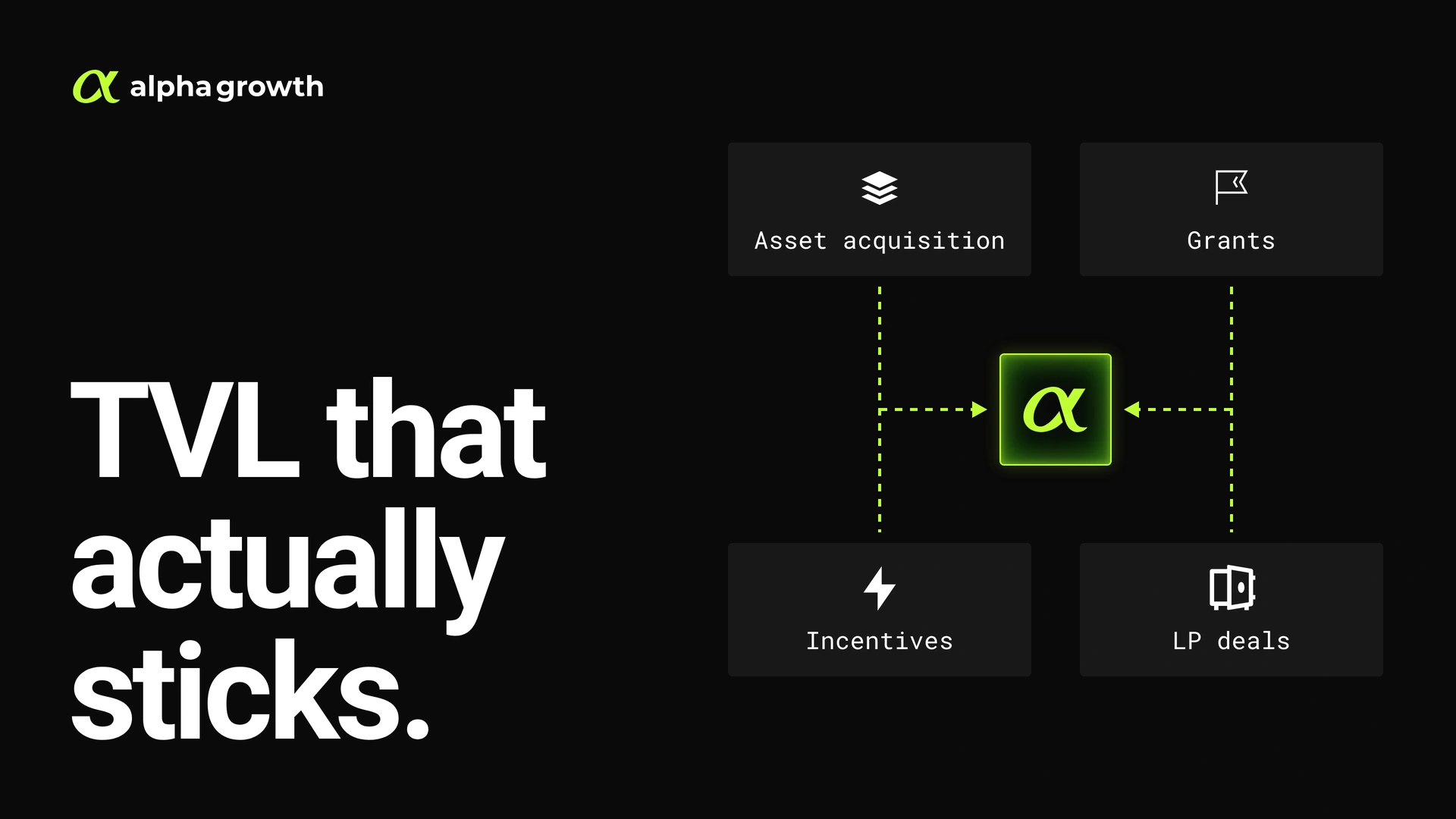
Blockchains and DeFi protocols grow Total Value Locked (TVL) sustainably by synchronizing four operational levers: onboarding external blue-chip collateral (asset acquisition), directing capital to execution-tested builders (milestone grants), calibrating rewards to prevent capital flight (retention incentives), and negotiating bilateral hurdle rates with institutional liquidity providers (LP deals).
Relying purely on inflationary token emissions attracts mercenary capital that vanishes when yields compress; building durable TVL requires turning balance-sheet liquidity into permanent on-chain collateral sinks.
The Mercenary Capital Trap: Why High APRs Fail
The conventional playbook for bootstrapping a new blockchain or protocol is predictable: allocate a massive native token ecosystem fund, subsidize DEX pools with triple-digit liquidity mining APRs, watch TVL spike to hundreds of millions, and watch that capital vanish the moment emissions taper off.
This dynamic is driven by mercenary capital. Yield aggregators and automated farmers route liquidity wherever short-term yields are highest, sell reward tokens immediately on spot markets, and withdraw principal the instant nominal APRs dip below alternative benchmarks.
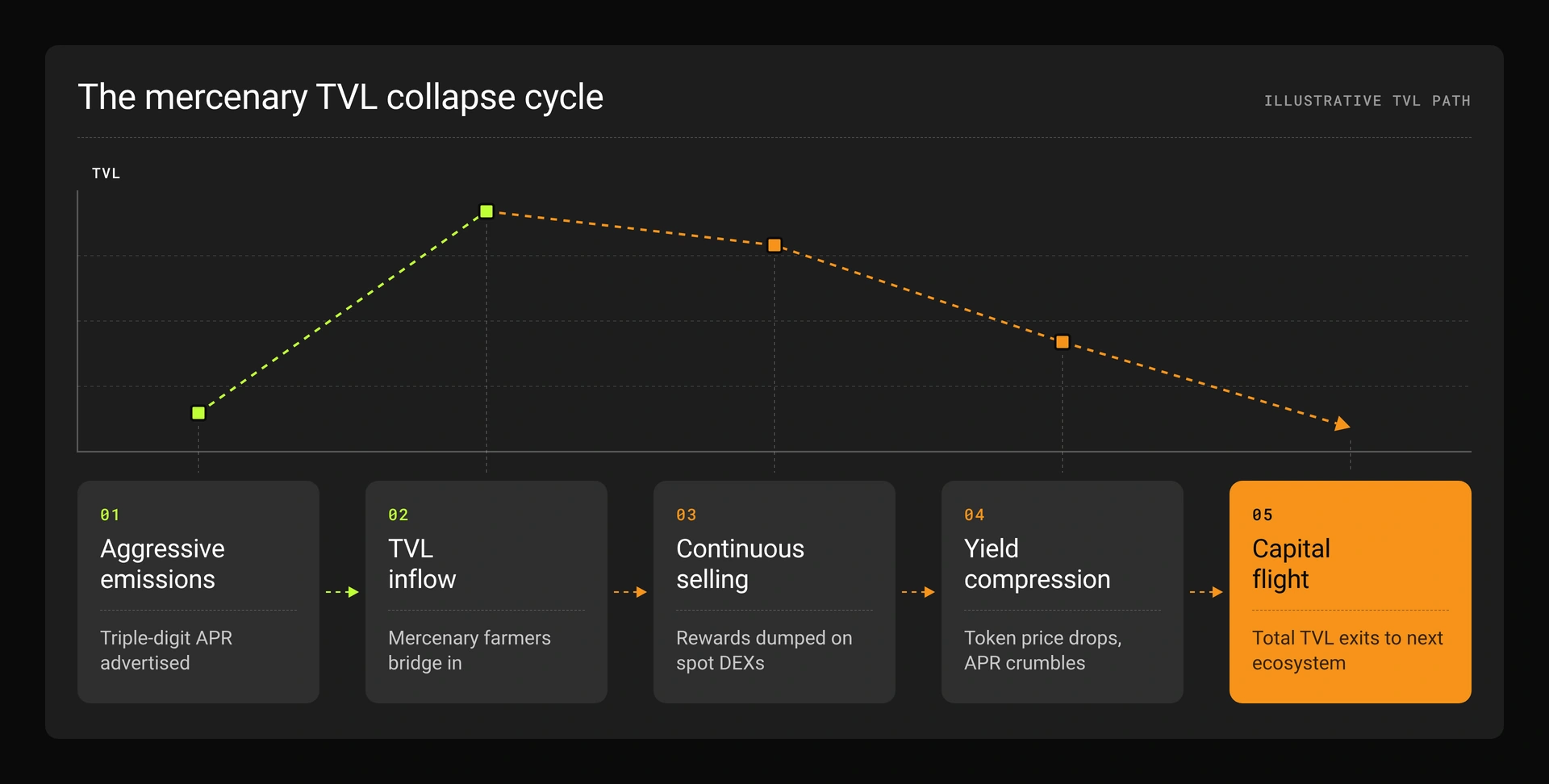
Treating liquidity growth purely as an emissions sprint creates structural sell pressure on the native token while failing to seed real economic activity. Sustainable Total Value Locked requires orchestrating four operational growth levers that turn temporary deposits into permanent, productive collateral sinks.
Lever 1: Blue-Chip Asset Acquisition (The Foundation Layer)
An L1 or L2 ecosystem cannot build a resilient DeFi economy solely on its native governance token. Single-asset ecosystems suffer from reflexive fragility: when the native token drops in price, money market borrowing capacity contracts, DEX liquidity thins, and TVL collapses in tandem.
Sustainable TVL requires onboarding external, non-correlated collateral—specifically Bitcoin, Ethereum, and regulated fiat-backed stablecoins:
Establishing Native Stablecoin Railing: Bringing native issuers (such as Circle for USDC or Tether for USDT) onto the network. Without trusted fiat settlement rails, institutional market makers refuse to deploy working capital.
Onboarding Blue-Chip Assets: Bridging BTC and ETH into wrapped or canonical representations gives decentralized lending markets and CDP debt engines uncorrelated collateral to underwrite loans during high volatility.
Collateral Diversification: A healthy ecosystem maintains an asset composition where the native token represents less than 50% of total collateral, shielding the chain’s credit infrastructure from localized token drawdowns.
Foundations monitor aggregate asset breakdowns using tools like Alpha Growth Chain Rankings to track the ratio of bridged blue-chip collateral relative to native governance tokens.
Lever 2: Funding Execution Over Code (Strategic Grant Structuring)
Most ecosystem grant programs fail because they distribute capital across speculative hackathon projects with no path to commercial viability. Foundations give away capital upfront, and teams abandon maintenance when the grant money runs out.
Building durable TVL requires transitioning from "spray-and-pray" developer bounties to institutional grant structures:
Milestone-Based Disbursements: Grants must never be paid in full upfront. Capital is tranches against measurable operational hurdles: testnet delivery, third-party security audits, mainnet deployment, and 60-day retained TVL targets.
Underwriting Founder Execution: Institutional ecosystems prioritize teams with commercial track records. Successful protocols fund founder operational execution and business development capabilities rather than passive code forks.
Core Primitive Prioritization: A new chain does not need twenty competing decentralized exchanges. It requires seven essential primitives deployed in sequence: a canonical DEX, an isolated lending market, a native stablecoin, a liquid staking protocol, an oracle network, institutional custody infrastructure, and an analytics indexer.
Lever 3: Designing Retention-Driven Incentives (Staccato Calibration)
To prevent the mercenary farm-and-dump cycle, incentive architectures must treat rewards as customer acquisition investments rather than permanent protocol subsidies.
The Staccato Incentive Model
Continuous, predictable emissions give automated yield aggregators a predictable target to extract and sell. In contrast, a staccato pacing model runs incentives in focused bursts:
The Cycle: Deploy targeted incentive programs for two weeks, pause rewards for two weeks, and measure cohort retention during the hiatus.
The Diagnostic: Did capital remain in the pools to earn swap fees and protocol utility, or did it instantly bridge out? Pacing emissions allows growth leads to calibrate reward sizing to the lowest effective APR necessary to retain deposits.
Token Holder Cohort Analysis
Incentivizing arbitrary addresses rewards participants who have zero affinity for the network. By conducting on-chain cohort analysis, protocols identify the secondary assets held by their target users and route incentives directly to those pairs (e.g., matching rewards on ETH/USDC or BTC/USDM rather than inflationary farm tokens), attracting depositors with genuine ecosystem alignment.
Lever 4: Structuring Institutional LP Deals
Institutional capital does not browse Twitter or join Discord to find high-yield farms. Private credit funds, family offices, and institutional market makers deploy eight-figure capital blocks through bilateral agreements governed by institutional hurdle rates.
Every institutional liquidity deal hinges on five core variables:
Variable | Institutional Requirement | Ecosystem Trade-Off |
|---|---|---|
1. The Chain Environment | Audited bridge security, battle-tested RPCs, qualified custody | Requires enterprise custody integration (e.g., Safe, Fireblocks) |
2. Risk-Adjusted APR | Net yields that clear the cost of capital without unhedged tail risk | Must offer organic return streams alongside base rewards |
3. Required Token Pair | Low-impermanent-loss pairs (stable/stable or correlated LSTs) | Harder to bootstrap long-tail governance token pairs |
4. Commitment Duration | Fixed lockup terms (3 to 12 months) paired with orderly unwind rails | Requires structuring clear term sheets and exit schedules |
5. Pool Capacity | Deep enough to absorb 5M–20M+ without crashing net yield | Mandates dedicated institutional vaults or isolated pools |
Foundations that master these five pillars can negotiate bilateral Letters of Intent (LOIs) and term sheets with major liquidity desks, securing millions in locked capital before public mainnet campaigns even begin.
Real-World Execution: Cardano PRIME & Compound Growth
Structuring sticky TVL and managing institutional liquidity require dedicated operational execution. AlphaGrowth’s growth framework demonstrates how strategic capital allocation compounds network value:
1. Cardano PRIME Program: Scaling Qualified Ecosystem TVL
When the Cardano community moved to allocate 120 million ADA to AlphaGrowth’s PRIME program, the mandate was built around scaling Cardano’s DeFi TVL from ~$90M toward more than $200M in net qualified growth.
The Execution: Rather than liquidating ADA to fund short-term inflationary yield, the program focused on bootstrapping core liquidity infrastructure and onboarding over $20M in external blue-chip assets onto Cardano.
The Result: The initiative onboarded independent stablecoins, deepened decentralized lending capacity, and secured cross-chain asset inflows as documented in the Cardano PRIME Program Discussion, expanding ecosystem TVL without introducing native token sell pressure.
2. Compound Growth Program: Securing Arbitrum’s Largest Grant
Expanding Compound V3 across multi-chain deployments required external capital efficiency rather than exhausting native reserves.
The Execution: Alphagrowth structured Compound’s application into Arbitrum’s Long Term Incentives Pilot Program (LTIPP), successfully securing a 1.8M ARB grant—the largest single grant awarded in that round.
The Result: These incentives were channeled directly into structured market-making programs and collateral pools across Arbitrum, driving borrowing activity and secondary market liquidity while keeping Compound’s core treasury fully intact.
Alphagrowth grows TVL for protocols and chains, and helps large token holders borrow against or earn yield on their holdings.
Looking to structure a sustainable TVL growth program or attract institutional liquidity to your ecosystem?
FAQ: Sustainable TVL & Ecosystem Growth
How do I grow my protocol’s TVL sustainably?
Sustainable TVL growth requires shifting away from uncalibrated liquidity mining and focusing on four core levers: acquiring external blue-chip collateral (BTC, ETH, stablecoins), funding builders through milestone-based grants, using staccato incentive pacing to measure retention, and negotiating bilateral terms with institutional liquidity providers.
How can a new blockchain attract DeFi protocols and liquidity?
New blockchains attract top-tier DeFi teams by deploying canonical infrastructure (oracles, cross-chain bridges, and qualified institutional custody), establishing native fiat stablecoins, and offering co-incentive packages that subsidize borrow/lend depth rather than speculative farming."
What is the difference between mercenary TVL and sticky TVL?
Mercenary TVL is automated capital that enters an ecosystem solely to harvest high reward emissions and leaves as soon as the APR drops. Sticky TVL consists of productive collateral deposited by long-term ecosystem participants, institutional LPs under term agreements, and users who rely on the network's financial primitives for organic borrowing, hedging, or trading.
Why do standard liquidity mining programs fail?
Standard programs release predictable token emissions that incentivize depositors to sell farmed tokens immediately on spot DEXs. This depresses the token’s market valuation, compresses the effective APR, and triggers mass capital withdrawals, leaving the protocol with depleted reserves and zero retained liquidity.
What is an institutional LP hurdle rate?
An institutional LP hurdle rate is the minimum return threshold required for a professional desk or fund to commit capital. It is calculated based on five deal terms: chain security and custody compatibility, net yield, the required token pairing (favoring low-impermanent-loss assets), commitment duration, and pool capacity.
For an operator breakdown on structuring institutional LP deals and aligning terms with institutional hurdle rates, watch How to Get Institutional LPs Into Your Protocol. This session examines the five components professional desks evaluate before committing capital.
Vuoi i dati più recenti su DeFi?
Prova il nostro MCP gratuitoNotizie correlate
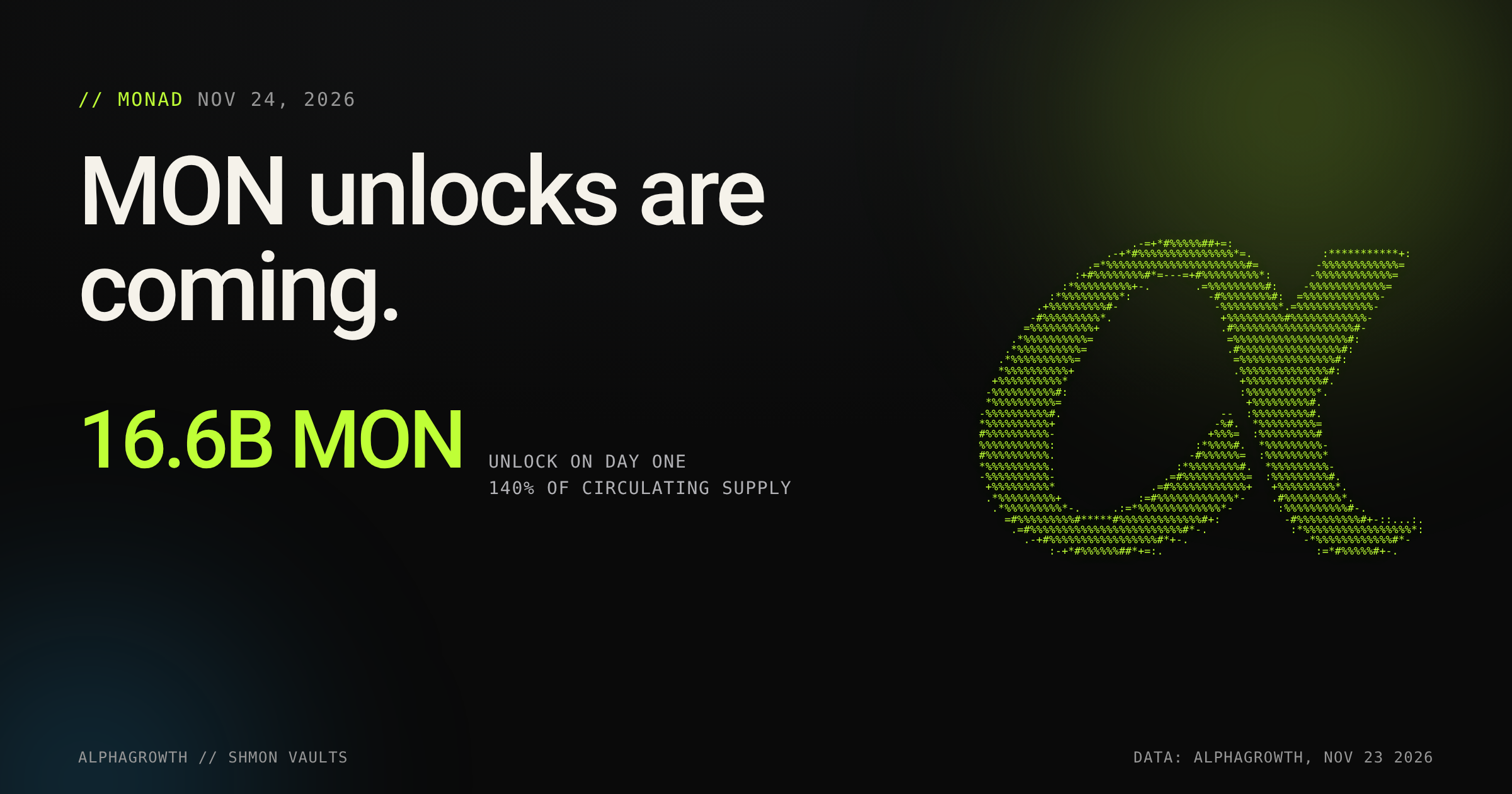
MON unlocks are coming: how to keep earning on your MON

AI Agents vs Vault Curators: Who Should Manage Your Yield?