MON unlocks are coming: how to keep earning on your MON
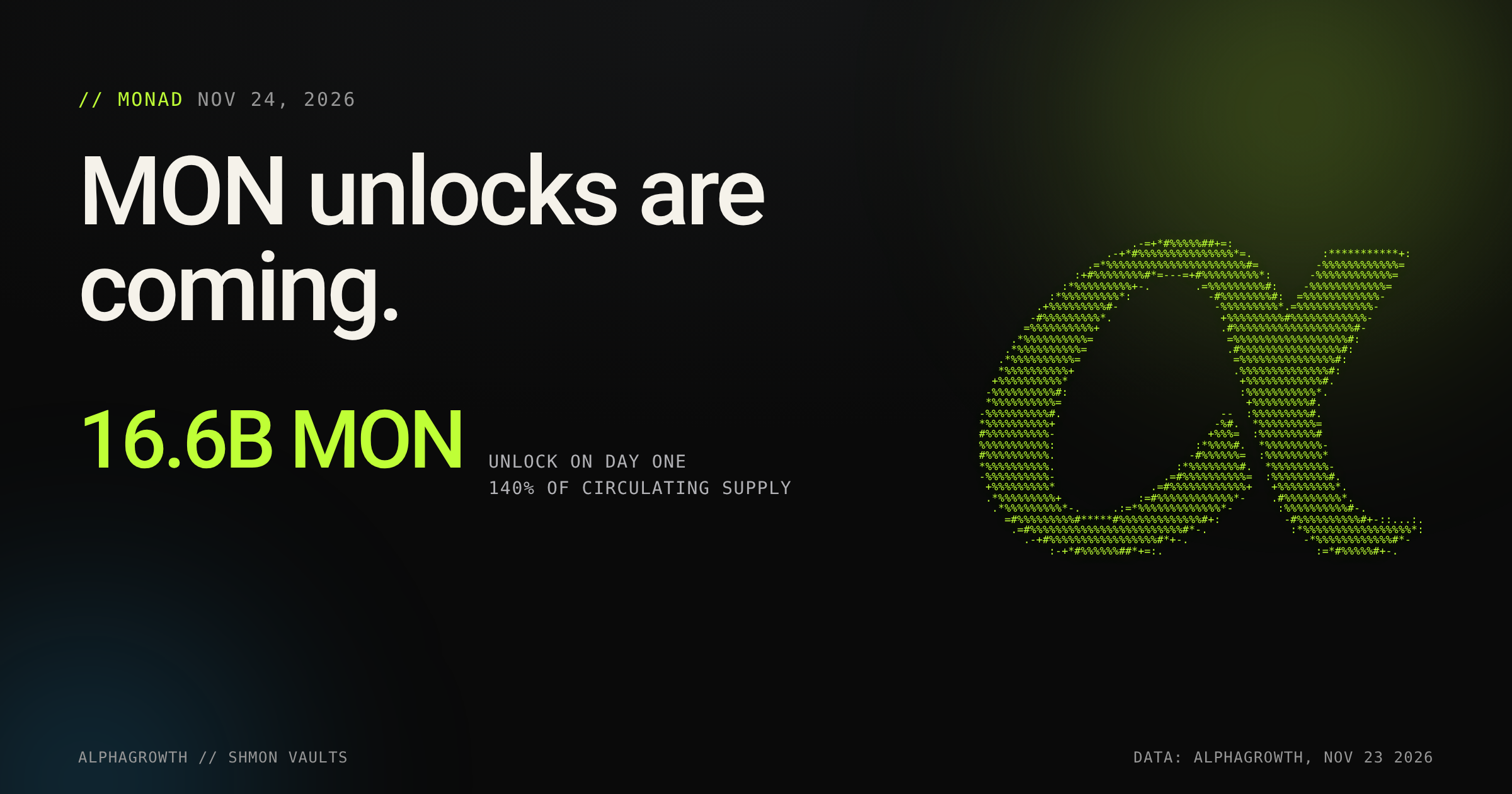
On November 24, Monad turns one. The same day, the one-year lock on team and investor MON ends.
If you hold MON that is about to unlock, you have three moves. Sell it. Leave it idle. Or put it to work.
We built two shMON vaults on Monad for the third move. One keeps your MON exposure and adds yield. The other hedges your price exposure and pays you in dollars. Both come with an exit desk, because on Monad the hard part has never been getting into staked MON. It's getting out.
A cliff, then a steady drip
On November 24, 16.6 billion MON unlock in a single cliff, according to AlphaGrowth's token unlock data: 10.7 billion for the team, 4.93 billion for investors and 988 million for the Category Labs treasury. At $0.0122 per MON, that's about $202 million, or 140% of the MON in circulation.
It doesn't stop there. Team tokens then vest at about 104 million MON a week through November 2029. On December 24, another 493 million unlock for investors and the treasury, and the same happens every month after that.
Treat the team figure as an upper bound for day one. Monad published percentages, not a dated schedule, and team tokens vest per person. Tokenomist models only 750 million team MON on the day, for 6.66 billion in total.
So this isn't a one-day decision. Everyone receiving MON will face the same question every month: what do I do with it?
Data: Alphagrowth, as of November 23, 2026. Tokenomist's model via TrustSwap.
Sink, don't sell: two vaults for unlocked MON
We say it to every founder we work with: the more places a token can go, the less of it gets dumped. Unlocked MON is no different.
The first place is staking. shMON is Fastlane's liquid staking token for MON. It earns staking rewards plus MEV, boosted through Chainlink SVR, and stays liquid. Our vaults at monad.structures.gg take that shMON one step further.
Each vault runs the same loop:
It supplies your shMON as collateral and borrows a stablecoin against it, on Neverland and on an Euler lending cluster.
It buys more shMON with the loan, up to a 43% loan-to-value (LTV) target.
It holds a short on Hyperliquid, sized to keep the vault at a fixed exposure to MON's price.
Chainlink price feeds price every vault in our Euler cluster.
The vault earns shMON's staking yield on the larger position, plus the funding paid to shorts, minus the borrowing cost. The only difference between the two vaults is how much price exposure you keep.
Vault | Exposure to MON's price | What you're paid in | Who it's for |
|---|---|---|---|
Delta One | 1, like holding MON | shMON | You're long MON and want more of it |
Delta Neutral | Close to 0 | Dollars | You want to protect the value of your unlock and earn on it |
You can move between them. Hedge with Delta Neutral while the unlock settles. Move to Delta One when you want the exposure back.
Live returns for both vaults are on the site, shown as trailing 7-day APR. They move with staking rewards, Hyperliquid funding and borrow rates, so check them on the day you deposit.
Getting out is the hard part, so we built an exit desk
Staking MON is easy. Leaving shMON in size is not. Today there are three ways out:
Route | What it can carry | Cost | Time |
Slow unstake through shMonad | No practical size limit | Free | About 19.6 hours (18.2–21.3 hours for 8 in 10 requests) |
Fastlane instant redemption | About $42,000 before the pool runs dry (read Nov 19) | 0.55–0.74% fee at that size | Instant |
shMON/WMON on Curve | About $23,000 at 0.28% under the rate, $46,000 at 1.06% | Slippage | Instant |
Read on chain, November 18–19, 2026. An aggregator like Kyberswap quotes 2.4% slippage to sell $86K of shMON for WMON.
For a person, a day-long wait is an inconvenience. For a levered vault, it's a liquidation risk: MON can move a lot in 20 hours. And in a selloff it gets worse: pools fill up with shMON, the instant redemption pool drains, and every leaver pays taker slippage. That has kept serious leverage off shMON.
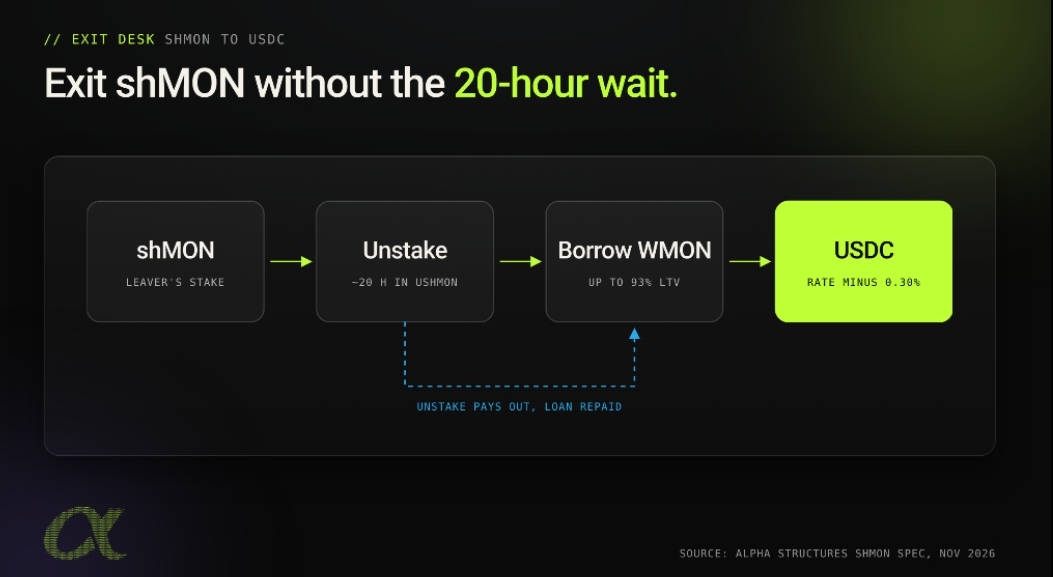
Our exit desk closes that gap. Each vault has one, and it works like this:
It parks the shMON in an unstaking vault (ushMON) on our Euler cluster and starts the slow unstake.
It borrows wrapped MON (WMON) against that position, at up to 93% of its value. WMON lenders earn 20–30% APR for this one-day line of credit.
It sells the WMON for USDC through its own Uniswap v4 pool, resting small maker orders one tick off the market, so it never pays taker slippage. A keeper fills them from the MON/USDC flow on other venues.
A day later the unstake pays out, and the desk repays the WMON loan.
The person leaving is paid in stablecoin at shMON's rate, less a 0.30% fee that goes back to the vault. A replay of 30 days of Monad trading sold $200,000 this way in 13.5–35.5 hours, depending on how much of the passing flow the keeper won. The limit is no longer how much shMON the pools can absorb, but how much WMON the market trades for USDC each hour.
The desk also runs a public pool that buys anyone's shMON at 0.30% under shMonad's live rate. Fastlane's instant exit charged 0.41–0.73% in 8 of 10 hours over the last 30 days. Any router on Monad can reach the pool whenever the vault isn't processing its own exits, so it adds depth for every shMON holder, not just our depositors.
What can go wrong
There is no free money. Here is what you take on:
Leverage. The vaults borrow against your shMON. A sharp MON move pushes the loan up. The bot pays down, unwinds and, at worst, sells at a loss to protect the vault.
Funding can turn. Hyperliquid funding is part of the return. When shorts pay instead of earn, the carry shrinks.
shMonad risk. If shMonad pauses unstaking or its rate drops (for example from slashing), the exit desk slows and its loans come under pressure.
Smart contract risk. ushMON was reviewed in-house, and every issue found is fixed and logged on GitHub. The code is public, and we welcome anyone to examine it. Reviews reduce risk. They don't remove it.
Close to neutral, not exactly. Delta Neutral rebalances toward zero exposure, so it drifts between rebalances.
Fees: Alphagrowth, as vault curator, takes 10% of performance gains. The 0.30% fee on shMON exits goes to the vault.
Built with
Monad: the chain the vaults run on.
Fastlane: shMON, the liquid staking token every vault holds.
Euler: the lending cluster and EulerSwap behind the exit desk.
Neverland: lends stablecoins against the vaults' shMON.
Chainlink: price feeds for every vault in our Euler cluster.
Before you decide what to do with your unlock
Selling is one option. Holding idle is another. We think putting MON to work, with a way out that doesn't cost you 1% or a day of risk, deserves a look.
See both vaults and their live numbers at monad.structures.gg. If you're receiving a large unlock and want to talk through Delta One versus Delta Neutral, book a call with our team.
Disclosure: AlphaGrowth built and operates these vaults and earns the performance fee described above. This post explains how the product works. It isn't investment advice.
トークンのアンロックの最新データが欲しいですか?
無料のMCPを試すプロトコルやチェーンのTVLを増やしたいですか?
AlphaGrowthは資産の獲得と統合、助成金、インセンティブ、LPディールによって、プロトコルとチェーンのTVLを伸ばします。
関連ニュース

What is a crypto MCP server? Free crypto data for AI agents, explained