AI Agents vs Vault Curators: Who Should Manage Your Yield?
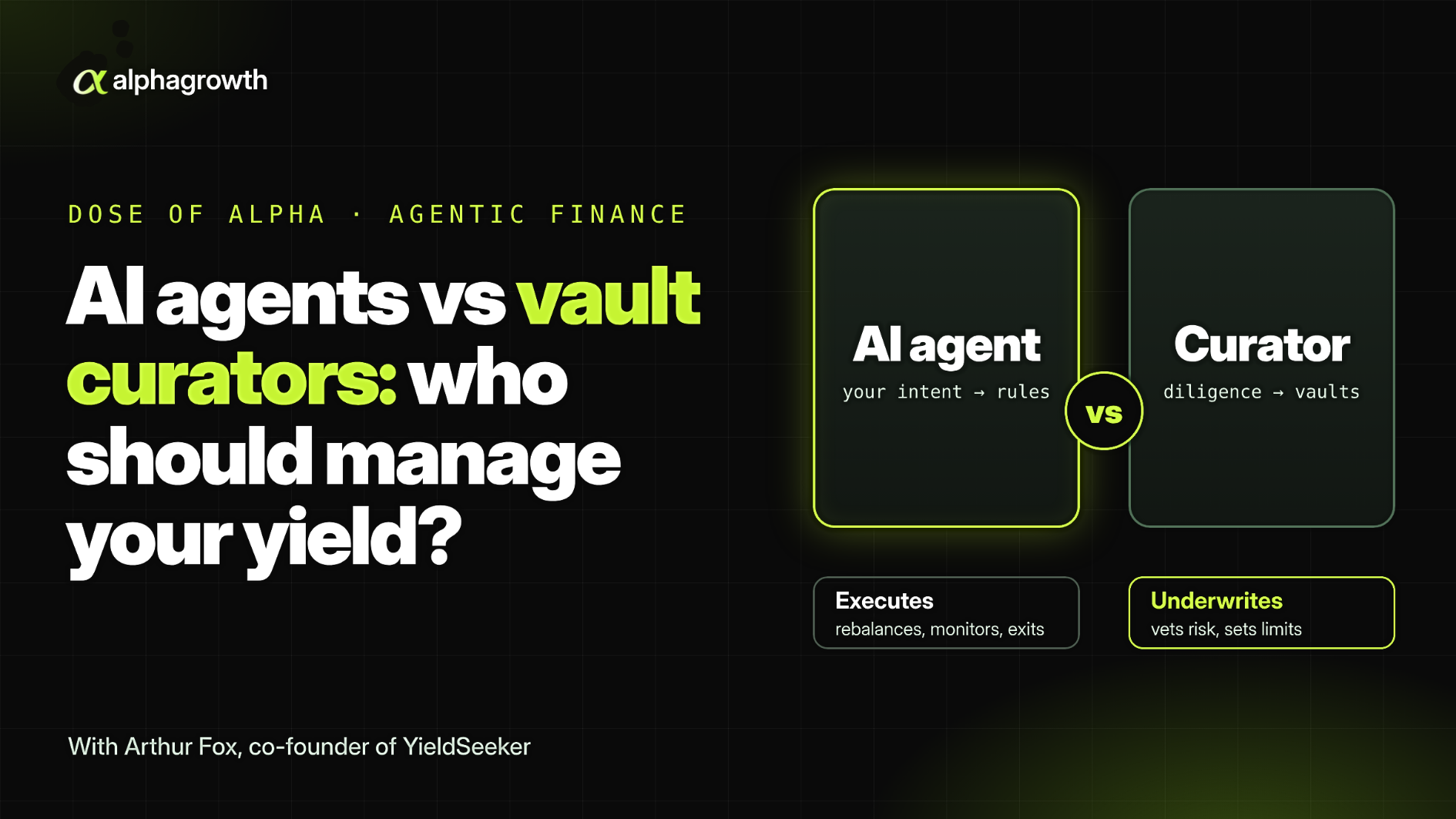
In five to ten years, a chunk of your financial life will be run by AI agents you talk to. That sounds like science fiction until you say it out loud. Then it sounds obvious.
That's the bet Arthur Fox is making. He's the co-founder of YieldSeeker, a platform that pairs two technologies he calls magical: generative AI, which does things when you speak to it, and DeFi, which lets anyone use finance from anywhere.
Arthur joined Bryan Colligan (founder, Alphagrowth) and Eric Waisanen (strategy, Alphagrowth) on Dose of Alpha Live. We met him at The Bridge, The Tie's event in New York, and picked up a conversation we started there: where does agentic finance go, and where should the line be?
A hackathon idea built on a decade down the rabbit hole
Arthur has been in crypto since 2016. He went to Ethereum meetups in the UK in 2017 and 2018 and, in his words, never climbed back out of the rabbit hole.
He started building in 2021 with his co-founder Christian. Arthur came from a payments company. Christian had been CTO of a firm building AI for hedge funds before the generative AI boom. Together they ran a small boutique dev shop, mostly on the NFT side, because that's where the market and the retail users were.
DeFi was always the part Arthur found most fascinating. It was also the part most people found hardest. How many ordinary people will open a MetaMask wallet and learn what a private key is?
The spark came from the AI agent wave at the end of 2024. Most of the agents launching on Virtuals felt like meme coins with an AI label.
Arthur's team asked a simpler question: what's the agent that actually makes sense to build? Their answer was yield.
That became YieldSeeker, an ETHGlobal hackathon project at Agentic Ethereum that won a Coinbase Developer Platform AgentKit prize.
Seeing Giza gain users with a similar agent was validation, not a threat. Someone else was building it, and people were using it.
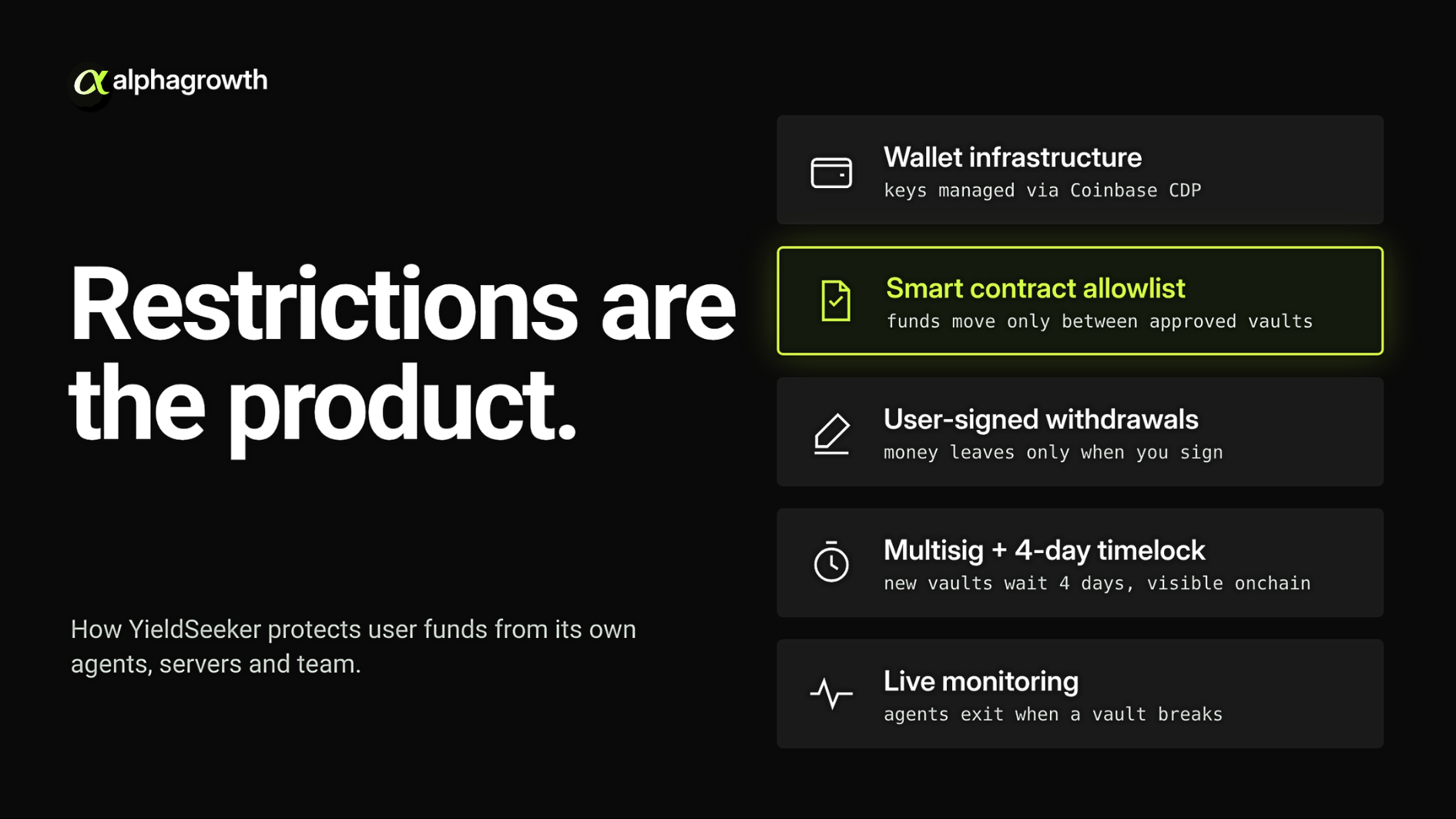
Security first: take yourself out of the equation
An AI money product has at least seven things to get right: a secure stack, a secure communication channel, the AI interface, good yield sources, diligence on those sources, capacity limits, and monitoring. Arthur was clear about which one comes first.
"I wouldn't be able to go to sleep," he said, if users' money could simply disappear. And this year, agents have made attackers faster too.
YieldSeeker's security is built in layers:
Wallet infrastructure. Wallets run on Coinbase Developer Platform APIs, which moves key-management risk to Coinbase.
A smart contract layer. Even then, a compromised server holding an API key was a risk. So the team added a contract layer, audited by Nethermind, that only lets funds move between approved vaults. Arthur's point: even the team can't take user funds.
User-signed withdrawals. Money only leaves when the user signs the withdrawal.
A multisig and a four-day timelock. Every new vault goes through the timelock and appears in an onchain panel users can see. If the multisig were ever compromised, the team would have four days to react.
Eric added the wider context. Solana programs push a lot of logic to the backend, so audits need to confirm that servers can't move funds on their own. Standards like ERC-7540 add asynchronous, request-then-claim deposits and redemptions. If an attacker gets into the backend but can only redirect funds to other approved strategies, the worst case is a suboptimal allocation, not a theft.
Restrictions are the product. Constraints are what make it safe to hand an agent your money.
Tell the agent your intent, not your instructions
Early versions of YieldSeeker let you say "move money from here to there." Arthur thinks that's the wrong job for an agent. Most people want to state an intention and let the agent handle execution.
So the product works in rules, not commands. You talk to the agent in plain language. It turns what you say into rules, and those rules run inside the guardrails of the smart contract.
The vault list is whitelisted. Arthur put it at around 40 vaults across about 10 protocols, including Morpho, Euler, Compound, and Aave.
Morpho supplies most of them. If you want to understand how curators and vault infrastructure fit together, we broke it down in Vault Infra Wars.
Two default profiles. Conservative sticks to a handful of well-known curated vaults: Steakhouse, Gauntlet, Spark, and Aave. Explorative opens up a wider range. Higher-risk venues like Avantis, which has withdrawal fees and real drawdown risk, stay off until you explicitly ask for them.
Custom rules in plain English. Only vaults above $10M in assets. Keep enough liquidity available to exit at any time. Only use one curator's vaults. The agent translates each instruction into a constraint.
Monitoring that acts on its own. Systems watch vault parameters like assets under management (AUM) and liquidity, plus outside signals from places like X. If a protocol has a problem, the team can block its vaults manually. Agents then pull liquidity out right away, though the automated thresholds will usually have fired first.
Eric asked the obvious stress test: what about a day like Oct 10, 2025, when markets crashed and "go find the highest yield" would have walked straight into trouble? The answer is the combination: whitelists, liquidity thresholds, and the ability to pull out the moment something breaks.
A day in the life of an agent
Agents don't all rebalance at the same moment. How often an agent acts depends on how much it manages.
With $10 in an agent, moving between vaults rarely makes sense. Gas and other small costs eat the gain. As a balance grows, the agent moves into higher tiers that can act more often. Users on the Pro plan get bumped up a tier, which can mean more frequent checks and allocation across two or three vaults.
Checks run on a queue, so timing varies by agent. Continuous monitoring sits on top of the schedule. If something breaks, the agent acts, even while you're asleep.
You don't need the web app to stay in the loop. A Telegram integration lets you talk to your agent there and get daily or weekly updates on what it did.
Bryan, who runs 15 to 20 AI agents of his own, sees where this goes. Picture a set of specialist agents in your daily life: a news scout, a research agent, a yield agent. YieldSeeker would be the financial employee in that stack.
Mars is the vision. Satellites pay the bills.
Arthur borrowed a metaphor from SpaceX. Mars is the goal. Satellites in low orbit are what actually ships today. Both matter, and they're very different jobs.
Mars: personalized agentic finance. You tell an orchestrator agent, or a team of sub-agents, to "manage my finance." Bryan, Eric, and Arthur each have different risk tolerances, so each gets a different outcome.
As crypto and TradFi merge, someone in Southeast Asia or Africa could ask an agent for a mix of dollars, Bitcoin, and an S&P 500 exposure, and it just happens. More sophisticated users get more advanced agent types: carry trades, liquidity management on DEXs (decentralized exchanges) like Uniswap, and beyond.
Bryan framed it in TradFi terms. In the US, much of the money is managed by registered investment advisers (RIAs). Agentic finance is an onchain, AI version of that, personalized to you.
Satellites: yield and rebalancing today. In the short to medium term, YieldSeeker focuses on yield optimization and on being embedded inside other platforms. It's also building portfolio rebalancing agents, such as holding a fixed split between BTC and USDC.
The bigger idea is personalization. Arthur's argument: the Industrial Revolution was about mass production. Everyone got the same coat, the same car, the same dose of ibuprofen. AI moves the other way.
Personalized service used to mean a tailor or a private banker. AI can make it cheap.
The human role changes too. In a car factory, robots do the work and a person checks the catalytic converter didn't end up in the wheel. With agents, you check your BTC didn't end up in the wrong place. Arthur's line: devs have all become CTOs. They don't read every line of code anymore. They validate the outcome.
We put it this way at AlphaGrowth: we take inefficient capital and make it more efficient. That's finance in one sentence. YieldSeeker is doing it with agents. We're doing it with liquidity, lending, and structured products. Same job, different tools.
F, marry, kill: agentic finance, the DeFi mullet, and RWAs
Every guest plays our narrative game. This round: agentic finance, the DeFi mullet (fintech in the front, DeFi in the back, like Coinbase's lending product running on Morpho), and real-world assets (RWAs).
Arthur married agentic finance, since he's already married to it. He killed RWAs, with a twist. They won't die. They'll stop being a category. We'll just say "the stock market onchain" or "commodities onchain." He kept the DeFi mullet close, because it's how most people will reach agentic finance in the first place.
Bryan also killed RWAs and called them an existential risk. He sees the mullet as short-term: you sell into someone else's distribution, and you take a discount for it. Over a long enough horizon, he expects more users to choose self-custody and onchain venues like Hyperliquid as hacks keep hitting centralized platforms. We've made the long version of that argument in Distribution Always Wins in the End.
His bigger point was about entropy. AI already creates more research than anyone can read or verify. General models know more than he does about almost everything, but they fall short in the one niche where he's an expert. That last 1% of expert judgment is the alpha. That's why YieldSeeker's vault diligence matters so much.
Eric married agentic finance and killed the mullet. Within five years, he argues, the generation coming up will trust a personal agent more than an institution. The model becomes B2AI: agents serve retail users, and curators serve the agents.
He picked RWAs for the F, because commodities will finally trade fast in permissionless markets. His caveat: privacy is the biggest blocker, so the mullet still has a good five-year run.
Where YieldSeeker stands, and who Arthur wants to meet
YieldSeeker is live. Arthur says users have created more than 5,000 agents, mostly retail, and that the platform has held over $1M and moved more than $450M in volume since launch. The team's own project listing also cites 5,000+ agents and announces a basis trade agent on Arbitrum, its first beyond its original chain.
The growth channel Arthur is most excited about is B2B2C: YieldSeeker agents embedded inside other apps, where end users never leave the host product. He's also talking with institutions about pure B2B use.
Who he wants to hear from:
Retail users who will try it and give honest feedback
Wallets, neobanks, and fintechs with users who'd want an agent managing yield
Anyone running a DeFi-wallet-style app looking for an embedded yield product
You can find Arthur on X (@afoxinweb3) and Telegram (@a_ffox), and through his Web3 newsletter. YieldSeeker is at yieldseeker.xyz.
Agents do the work. You check the work.
Everyone on the call landed in the same place. Agentic finance is where this goes. The open questions are about trust, distribution, and diligence, not about whether it happens.
The winners won't be the agents that chase the highest number on the screen. They'll be the ones with the tightest guardrails, the best-vetted vaults, and a path into the apps people already use.
Agents are the new interface. Curators are the new underwriters. Distribution still decides who wins.
Building a protocol, vault, or ecosystem that agents should be routing capital to? Talk to Alphagrowth.
Disclosure: Alphagrowth curates lending vaults on Euler, one of the protocols mentioned above. Nothing in this article is financial advice.
DeFi 수익률에 대한 최신 데이터가 필요하신가요?
무료 MCP 사용해 보기관련 뉴스
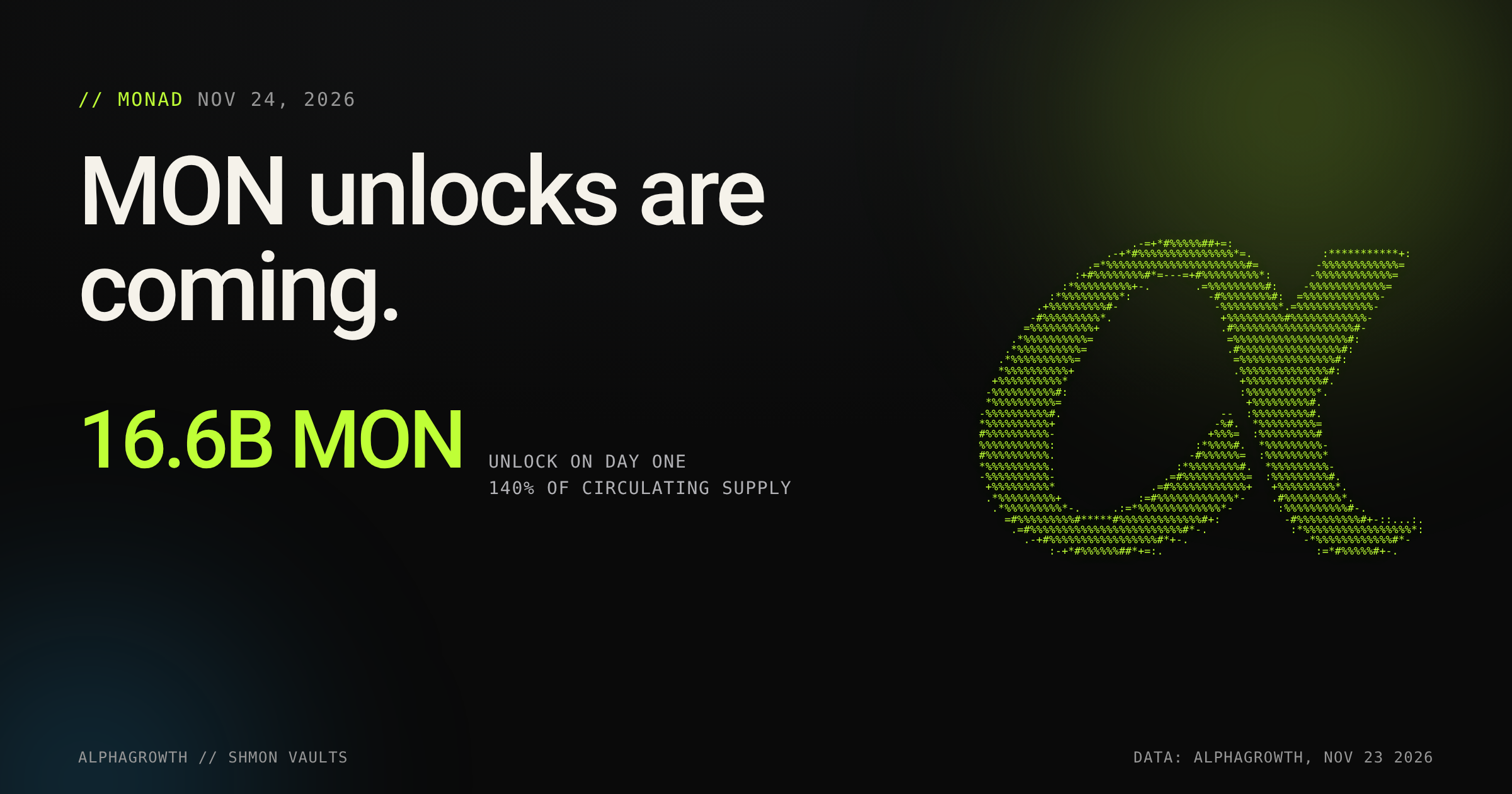
MON unlocks are coming: how to keep earning on your MON
What is a crypto MCP server? Free crypto data for AI agents, explained