Earning Yield on a Large Token Position
Treasury diversification and founder runway are routinely treated as binary decisions: hold idle tokens and remain cash-constrained, or liquidate native tokens on the open market.
Selling a seven- or eight-figure token allocation introduces three structural penalties:
Severe Narrative Damage: Open-market sales by founders, foundation addresses, or multisigs signal desperation or waning conviction, frequently triggering cascading sell-offs across the broader community.
Order-Book Depletion & Price Slippage: Thin bid liquidity across decentralized and centralized exchanges turns large market orders into self-inflicted price crashes.
Permanent Loss of Governance & Future Upside: Selling permanently liquidates
Rather than liquidating, sophisticated operators treat their native balances as collateral. The optimal execution track depends on immediate capital requirements: accessing non-dilutive debt for the runway or generating recurring cash flow from idle reserves.
Track 1: Borrowing Against Tokens for Immediate Liquidity
For projects and funds needing capital for payroll, infrastructure costs, or strategic acquisitions, token-backed loans provide spendable liquidity while preserving token ownership.
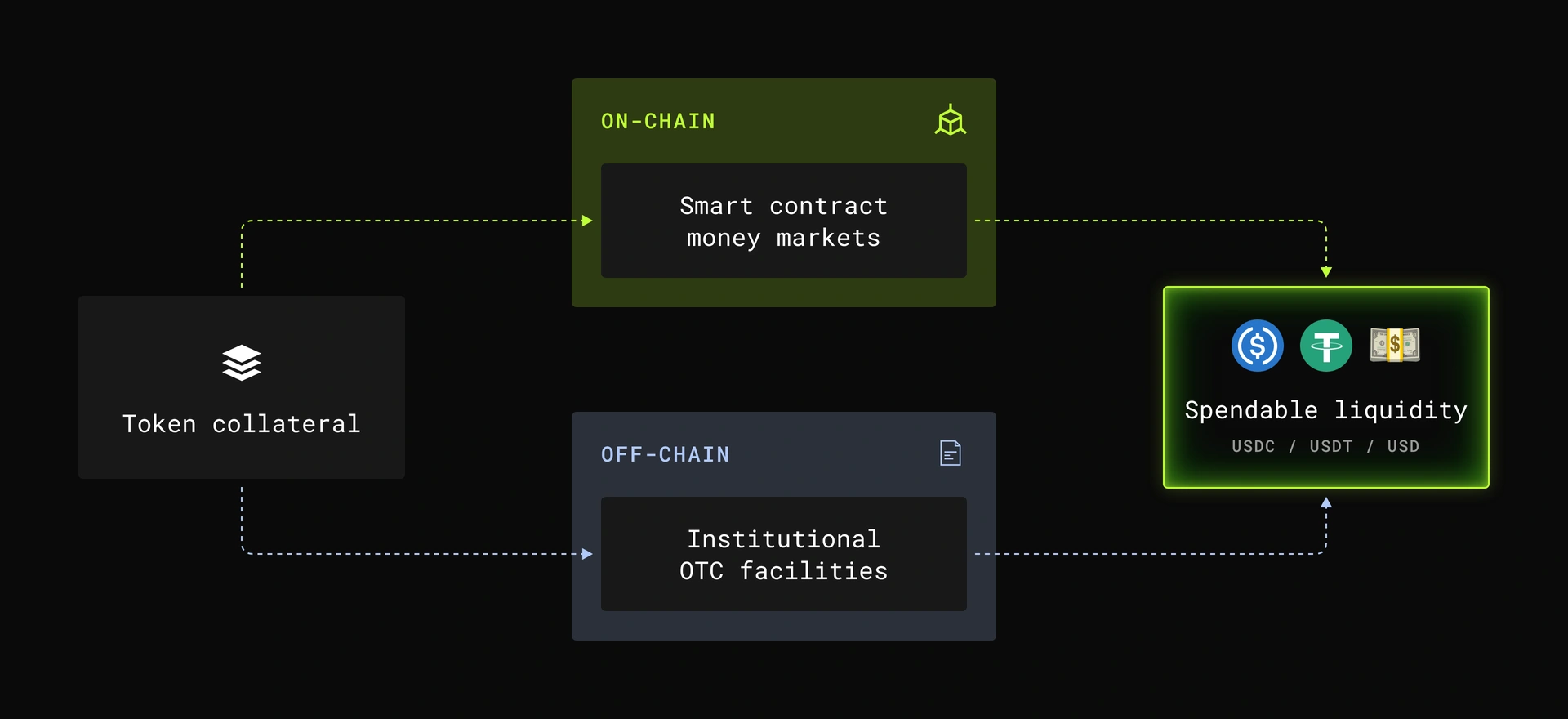
On-Chain vs. Off-Chain Crypto Lending
Parameter | On-Chain Lending Protocols | Off-Chain (OTC) Credit Facilities |
|---|---|---|
Execution | Automated, instantaneous smart contracts | Bilateral term sheets (1–2 weeks diligence) |
Asset Support | High-cap, deeply liquid assets | Native tokens, altcoins, & unvested allocations Knowledge Base - Gemini Chat |
Liquidation Engine | Instant algorithmic auction on DEXs | Contractual margin call grace periods (24–72 hours) |
Custody Setup | Smart contract protocol pools | Qualified custodians & segregated multi-sig Knowledge Base - Gemini Chat |
Optimal Size | $100K – $2M positions | $5M – $20M+ concentrated positions Knowledge Base - Gemini Chat |
1. On-Chain Lending (DeFi Protocols)
On-chain markets (such as Aave or Compound) provide trustless, permissionless liquidity for liquid collateral.
Mechanism: You deposit tokens into a smart contract and borrow stablecoins against your position up to an enforced Loan-to-Value (LTV) limit.
Risk Factor: Algorithmic liquidation. If token volatility breaches the liquidation threshold, the smart contract immediately sells collateral on public DEXs, triggering steep liquidation penalties and price slippage.
2. Off-Chain OTC Lending (Institutional Credit Lines)
For foundations and founders holding long-tail assets or concentrated positions (5M–20M+), retail DeFi pools cannot absorb the size without creating solvency crises.
Mechanism: Credit is negotiated bilaterally with an institutional lender or private credit fund, with assets held through established SEC-compliant qualified custody frameworks.
Knowledge Base - Gemini Chat
Margin Call Grace Periods: Crucially, off-chain agreements provide operational buffers. Unlike automated smart contracts, institutional credit contracts typically specify a 24- to 72-hour margin call grace period, giving the borrower time to post additional collateral or pay down debt before any liquidation can take place.
Borrowing Against Locked or Vesting Tokens
Founders and early contributors often hold substantial paper wealth trapped behind multi-year vesting schedules or cliffs. Standard DeFi protocols cannot underwrite illiquid, unvested tokens. Specialized institutional lending desks solve this through bespoke underwriting:
Underwriting Criteria: Risk teams evaluate the project's fully diluted valuation (FDV), underlying protocol revenue, emission schedules, and cash runway.
Conservative LTVs: Loan-to-Value ratios are set between 15% and 35% to insulate the credit facility against severe drawdowns.
Custodial Escrow: Collateral is pledged via programmatic multi-sig or legal escrow, allowing founders to unlock operational liquidity years before token lockups expire.
Track 2: Earning Yield on Large Token Positions
(Structured Product Vaults)
When a treasury does not need upfront liquidity but holds an idle balance of 10M–20M+, the goal is generating recurring cash flow without selling.
Why Retail Yield Vaults Fail for an Eight-Figure Balance
Depositing $15M into a standard retail lending pool or yield aggregator causes immediate yield compression:
The supply of borrowable tokens vastly exceeds market demand, collapsing the borrowing APR toward zero.
The protocol pools risk across unknown retail counterparties and unvetted smart contracts.
Secondary liquidity is insufficient to unwind an eight-figure position cleanly during black-swan events.
Institutional-scale balance sheets require isolated structured product vaults built on market-neutral derivatives.
1. Funding-Rate Arbitrage (The Perpetual Basis Trade)
Funding-rate arbitrage is a market-neutral strategy that captures periodic payments exchanged between long and short traders in perpetual futures markets, eliminating directional market risk.
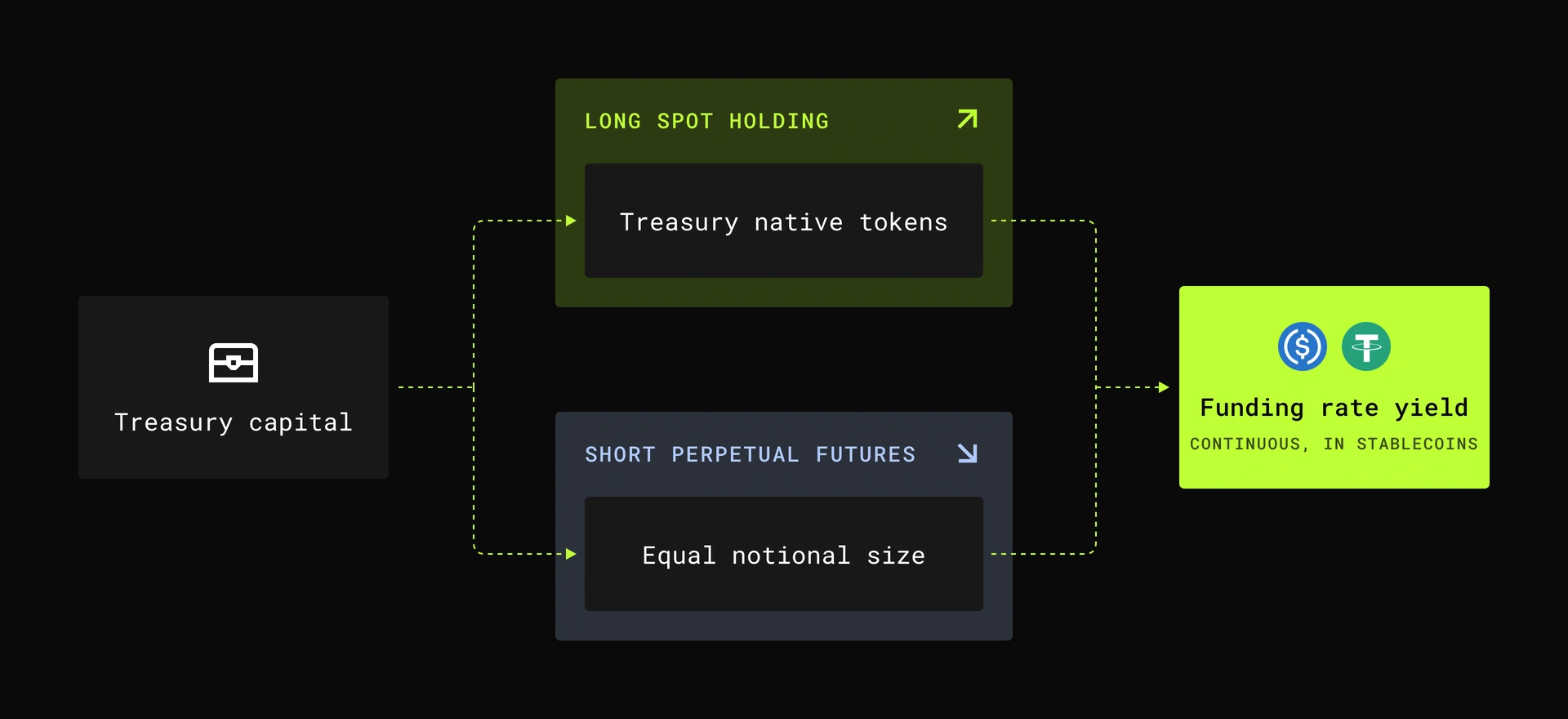
The Setup: The treasury holds its native tokens as the spot leg and executes an equal-sized short perpetual futures position on an institutional derivative exchange.
The Yield: Because the short position offsets spot price fluctuations, the portfolio remains delta-neutral. In normal market conditions where perpetuals trade at a premium to spot, leveraged long traders continuously pay funding fees to short holders.
The Result: The treasury collects sustainable, stablecoin-denominated yield driven by market demand for leverage rather than inflationary token emissions.
2. Volatility Capture (Systematic Options Overwriting)
Volatility capture is an options-based strategy that monetizes the structural volatility of an asset by selling options premiums to institutional market makers.
The Setup: The treasury deposits its native tokens into a custom covered call vault and systematically writes out-of-the-money (OTM) call options with strike prices 20% to 40% above the spot price.
The Yield: Market makers pay upfront cash premiums to purchase that upside volatility.
The Outcome: If the token trades below the strike price at expiration, the options expire worthless: the treasury retains 100% of its native tokens and keeps the premium as realized yield. If the token surges past the strike price, the treasury exits a predefined fraction of tokens at an elevated valuation, completely avoiding DEX slippage.
Operational Execution: Cardano, Compound, and Uniswap
Deploying ecosystem capital, managing risk, and engineering non-dilutive liquidity require operational execution. The same rigor applied to founder credit facilities and structured vaults drives programmatic growth across top-tier ecosystems:
Cardano PRIME Program: The Cardano community approved an allocation of 120 million ADA to AlphaGrowth’s PRIME growth program to scale DeFi TVL past $200M. As outlined in the Cardano PRIME Program Discussion, the strategy focused on bootstrapping liquidity infrastructure and onboarding over $20M in external blue-chip assets (BTC, ETH, USDC), expanding ecosystem depth without dumping native ADA onto the market.
Compound Growth Program: In expanding Compound V3 across multiple chains, AlphaGrowth secured a 1.8M ARB grant—the largest allocation of that funding round—detailed in the Compound LTIPP Final Application. These external incentives were structured into strategic liquidity programs, scaling borrow and lend volume without touching native token reserves.
Uniswap Growth Program: During a six-month growth program documented in the Uniswap Growth Program Trial Recap, AlphaGrowth secured over $4.8M in incentives and deployed $950K+ to generate +$10M in incremental TVL. The initiative reached over 4M social impressions in a single month and 1.3M+ cumulative video views, showing how structured incentives deliver measurable liquidity without market dilution.
To benchmark how yields fluctuate across lending protocols and derivative venues, allocators regularly track data on Alpha Growth MCP to evaluate baseline returns before locking in private terms.
Alphagrowth grows TVL for protocols and chains, and helps large token holders borrow against or earn yield on their holdings.
Need to structure a custom credit line or generate yield on a concentrated token position?
FAQ: Non-Dilutive Capital & Treasury Management
How can a DAO earn yield on its treasury without selling its token?
A DAO can deposit native assets into custom structured product vaults utilizing market-neutral strategies like funding-rate arbitrage and covered call options. These structures extract organic yield from derivatives markets without selling tokens on spot markets or diluting governance holders.
How can a founder get liquidity without selling project tokens?
Founders can deposit native tokens as collateral with decentralized on-chain lending protocols or off-chain institutional credit desks. This provides immediate stablecoins or fiat for working capital while retaining token ownership and avoiding open-market selling pressure.
What is the difference between on-chain and off-chain crypto lending?
On-chain lending relies on public smart contracts for instant, automated borrowing against liquid tokens, with programmatic liquidation risk. Off-chain lending uses institutional OTC desks and qualified custodians, providing bespoke LTVs, non-public execution, and multi-day margin call grace periods.
Can you borrow against locked or vesting crypto tokens?
Yes. While retail DeFi protocols cannot accept illiquid collateral, specialized institutional lending desks can structure custom credit facilities secured by future vesting streams or programmatic timelocks
What Loan-to-Value (LTV) can I expect on token-backed loans?
LTV ratios reflect trading liquidity, depth, and historical volatility. Liquid blue-chip assets typically command 50%–70% LTV, whereas long-tail or unvested project tokens generally see conservative LTV ratios between 15% and 35% to protect against sharp drawdowns.
Why do retail yield vaults fail for a $20M treasury position?
Retail DeFi vaults lack the capacity to absorb eight-figure positions without collapsing the underlying borrow rate toward zero. Furthermore, retail protocols pool counterparty risk and lack the execution depth required to unwind large positions during high volatility.
What happens if the token price drops during an off-chain loan?
In off-chain credit facilities, price drops trigger a margin call rather than an instant liquidation. Borrowers receive a contractually defined grace period (typically 24 to 72 hours) to post additional collateral or repay part of the balance before liquidation occurs.
อยากได้ข้อมูลล่าสุดเกี่ยวกับ ผลตอบแทน DeFi ใช่ไหม
ลองใช้ MCP ฟรีของเราข่าวที่เกี่ยวข้อง
MON unlocks are coming: how to keep earning on your MON

AI Agents vs Vault Curators: Who Should Manage Your Yield?