Distribution Always Wins In the End. (AAVE inspired)
Most founders, myself included, learn the hard way: the best product rarely wins.
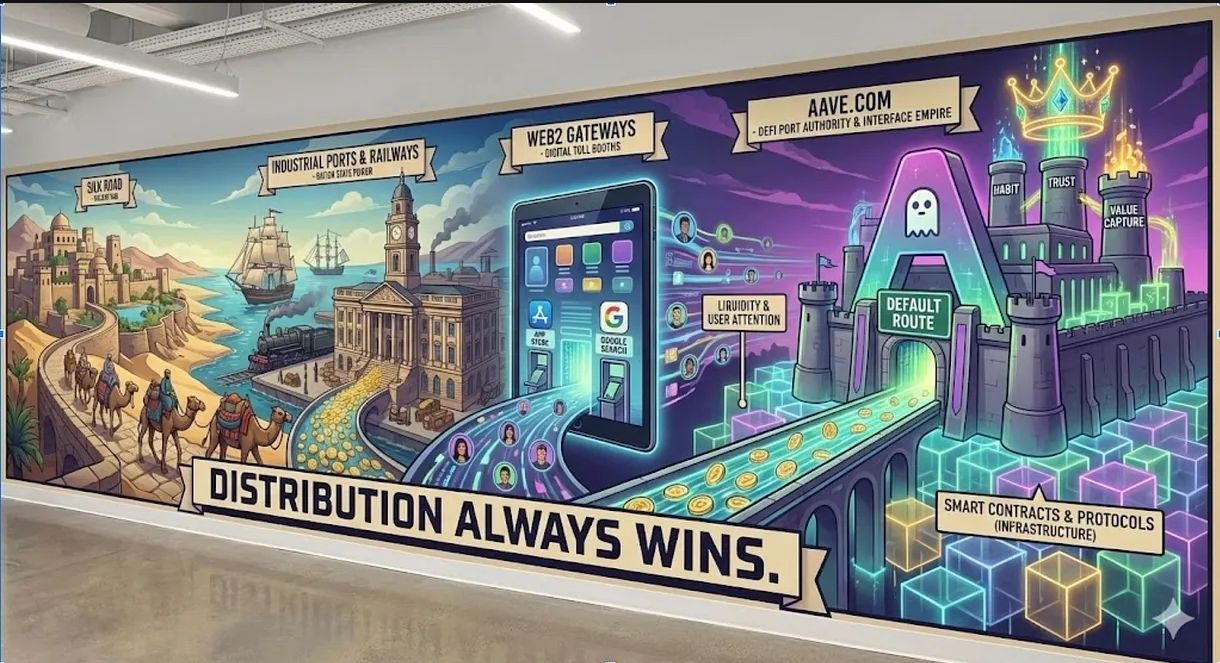
The winner is the thing that becomes the default behavior. Whether that is the store, exchange, or website. In DeFi, the trade route is increasingly the interface (aave.com), not the smart contracts. Over a long enough time horizon, distribution captures the margin, and the token leaks value unless it has a credible claim on the distribution surfaces.
Outline
- My White Whale
- Distribution is the moat
- The Aave debate is a distribution debate
- Why DAOs can’t “own the whole stack” (yet)
- The five value accrual layers in the Aave stack
- History lesson: trade routes become capital hubs
- The punchline
- What to do about it
My White Whale

I’ve got two recordings running. I’m caffeinated. I’m pacing. And I’m about to chase the same white whale I’ve been chasing since 2009.
For most of my early career 2005 through 2009 I lived inside the product. Databases. Performance. Bug testing. Reliability. Ship it. Make it work. I loved it. I still love it.
Then I started my first company and got punched in the face by a simple truth:
I didn’t know a thing about distribution.
My sales muscles were weak. No marketing instincts. No grasp of why two “worse” products kept winning over the thing I thought was objectively better. And once you see it, you can’t unsee it. It becomes a permanent cognitive scar.
From 2009 on distribution became my obsession. And getting back into crypto made it even sharper, because crypto repeats the same mistake with more confidence: we assume that if we build something brilliant, the world will recognize it and adopt it.
That assumption is wrong.
It has always been wrong.
And if you zoom out long enough, you realize the uncomfortable rule of reality:
Products compete. Routes compound.
The silent company killers

Everyone fights over product features because that’s where the ego lives. “We built the best protocol.” “We built the fastest app.” “We have the cleanest code.”
But winners fight over something less glamorous and far more powerful:
the chokepoints of distribution.
The ports. The rails. The exchanges. The app stores. The feeds. The default UIs.
Because once you become the route, you don’t need to win every product war. You just need to be the place users pass through to do the thing.
And once people pass through you repeatedly, you become the habit.
And once you become the habit, you can collect taxes.
Here’s the simplest framework I know:
Distribution is Capturing Default Behavior:
Default Behavior = Access + Trust + Value + Repetition
- Access: can people get to it?
- Trust: do they believe it won’t hurt them?
- Value: did you get utility? Fun, money, enjoyment, a story?
- Repetition: Can you get a user to do something 6 times to create the habit?
When you win those four, you can install your “toll booth”:
fees, spreads, rents, data collection, attention monetization, whatever your Dot com domain allows.
This is not a crypto story. This is a history story.
The Aave debate isn’t a governance debate. It’s a distribution debate.
Recently there’s been this debate around aave.com. DAO vs Labs, sparked by a seemingly small change: switching a swap routing provider and, with it, a meaningful change in revenue capture.
People are arguing about DAOs, governance, “value accrual,” fiduciary duties, surface area, who owns what, and where the line in the sand should be.
All valid.
But the core question is simpler and more brutal:
Over a long enough time horizon, does AAVE the token accrue the value, or does aave.com the distribution surface accrue the value?
History is unkind here.
Distribution accrues the value.
Not because the smart contracts aren’t important. They are. They’re genius. But because technology commoditizes over time, and the route captures the margin.
Where the protocol ends and the app begins
Here’s the part people hate admitting: the “DAO runs everything” dream collides with physics.
Smart contracts can live in what feels like Neverland. Ideological dreams, global, permissionless, not tied to any country.
But websites don’t.
To run a serious front end at scale you need: servers, a CDN (Cloudflare, etc.), lawyers, contracts, bank accounts, a legal entity, and usually a jurisdiction.
And that’s where the boundary appears:
If it requires a real-world entity to operate reliably, it becomes an attack surface.
You don’t attack the smart contract first, you attack the entity that hosts the domain, operates the CDN, signs agreements, controls the keys, manages the brand, and can be served papers.
This is where regulation has lived for years. Not because regulators understand smart contracts, but because they understand companies.
And here’s the darker twist: nation states can protect your domain and your trademark better than they can protect your smart contracts. If you pay taxes in a strong property-rights regime, you’re effectively buying long-term protection of your assets.
I once met an immigrant in the crypto industry paying taxes in america and I ask him about why the change in citizenship he said to me if I build in other countries I won’t be able to keep what I make over the next thirty years. You pay taxes because taxes in america will protect your creation and the dollars generated from your creation.
Right now, nobody is protecting your DeFi positions from a nation-state threat actor. Especially when Lazarus Group equates for 60% of GDP of North Korea.
So we end up in this weird place:
- the protocol wants to be outside the system
- the distribution layer is inevitably inside the system
And that tension is the real story.
The five layers of value accrual in the Aave stack.
To make this debate sane, you have to separate the stack into layers
1. Protocol cashflows (clean, on-chain, obvious)
Reserves, flash loan premiums, liquidation fees, GHO spreads. This is the “pure” protocol business. This is what tokenholders naturally expect to govern and capture.
2. Distribution surfaces (the battlefield)
aave.com / app.aave.com
Defaults. Swap routing. Funnel control. Brand trust. The habit loop.
This is where people actually interact, even if the protocol is permissionless. And this is where “soft governance” happens, because default behaviors shape flows.
3. Product verticals (the incubator layer)
Swapping. Vaults. Automation. Institutional products. Liquidation engines. These start as “extras” and sometimes become the real business.
This is basically an internal venture studio: small experiments that can become giant revenue lines downstream and future products and partnerships.
4. IP, trademark, and domain governance
The brand is licensable. The domain is a choke point. The trademark is power.
Especially in open source software, If you control these, you can decide who gets to be “official and canonical”
5. The influence / incentive economy (the dark layer)
This is the part nobody likes writing down: the ecosystem deal flow, the chain incentives, the political capital, the coalition-building, the “who gets what for supporting what.”
Call it influence. Call it incentives. Call it status. But it’s a layer of value and it shapes decisions.
Now step back.
If Distribution and IP/domain are outside the token’s economic claim, you have a value leakage problem.
And “value leakage” is just a polite way of saying: tokenholders are holding the bag while the route prints cash.
History’s verdict: the route accrues the value

This is where I nerd out, because history is the cleanest mirror we have.
The Ancient Silk Road wasn’t a single line on a map, it was a living network of intermediaries, protection markets, credit relationships, and caravan hubs. The “product” was silk, spice, and novelty. But the durable wealth came from controlling the passage: who could move safely, who could finance a trip, who could enforce a contract, who could collect a toll.
Distribution turns geography into leverage.
The Ottoman Empire had this leverage. A chokepoint between East and West didn’t just move goods, it became a gravitational center for money, diplomacy, and institutional power. Chokepoints become capitals because they turn “traffic” into a durable tax.
Once the traffic is big enough, something even more interesting happens: financial primatives form around the route.
Venice and Genoa we see this again. Where maritime distribution didn’t stay “shipping” for long. It created early banking, bills of exchange, insurance, and credit. Once the flow matters, you need ways to underwrite risk and settle trade without hauling literal gold across oceans.
The value accrual machine scales.
Amsterdam turns distribution into a system and creates stocks. The route stops being a path and becomes a platform. And from there, it’s a short step to London, where the stack becomes complete: navy protection, insurance underwriting, banking, courts, and global contracting. London’s advantage wasn’t a better spice. It was a better system for moving spice at scale, insuring it, financing it, and enforcing deals.
Sometimes distribution doesn’t just crown a city, it rewires the entire map.
The Suez Canal and the Panama Canal are basically geographic hacks. They collapse time, compress cost, and reroute global commerce overnight. Whoever controls the shortcut controls the toll. And once you understand that, you realize the “product” is often irrelevant. The real product is time compression, because time compression becomes a permanent advantage that everything else organizes around.
In the American story, distribution doesn’t create wealth, it creates the state.
Not only taxation without representation, In the 1800s, the New York City Customs House was a power center because customs revenue was a major funding source for the federal government. If you control the port, you control the tolls. If you control the tolls, you shape politics. Distribution becomes governance whether anyone calls it that or not.
And when distribution moves from goods to capital, the leverage gets even higher.
The NYSE is a trade route for money itself. Its moat isn’t “the best companies”, it’s liquidity, standards, and trust. Once enough capital routes through one venue, that venue creates a gravitational field: price discovery forms there, narratives form there, and everyone else is forced to reference it.
Then the physical world gets a hard reset with a single primitive:
Containerization.
Once shipping containers standardized global logistics, the planet became one giant, cheaper factory floor. Costs collapsed. New ports won. Old ports died. New manufacturing hubs emerged. The route changed and power followed to China.
Digitization. Watch the routes become invisible but even more powerful.
Google Search becomes the port authority of the web. Ranking becomes the route. Businesses don’t just compete on product. Trade flow goes to placement on the road people actually travel. Entire industries (SEO, performance marketing) form around winning distribution because distribution is where compounding happens. Winner’s here are Google, Zappos and Amazon.com
Then mobile does it again:
The App Store.
A literal digital customs house. Distribution, payments, and rules of engagement in one place. Once you control the store, you can tax the economy built on top of it, because you control the default path from desire to download.
Finally, crypto shows you the same pattern in high resolution.
First, exchanges like Coinbase and Binance gave global access to purchasing bitcoin and monetized the on-ramps, order books, liquidity, and listings. Even in an “open” asset system, order flow concentrates because trust and convenience concentrate. Liquidity is distribution.
And then DeFi gets its own version of the customs house.
This is the part people don’t want to admit because it punctures the mythology. Protocols are permissionless, sure. But users don’t experience “permissionless.” Users experience defaults. They go to the place they trust. They click the path that is easiest. They use the domain that feels official. That’s why the debate around aave.com hits so hard: because it’s not just a website. It’s a route.
The punchline
Technology commoditizes. Distribution compounds.
Smart contracts, brilliant as they are, trend toward becoming infrastructure. Infrastructure gets copied. Forked. Repriced. Abstracted. The differentiation collapses toward zero over time. Meanwhile the interface, the route, collects habit, trust, and attention. It becomes the default. And once it becomes the default, it installs a toll booth.
So when you ask whether value accrues to a token or to an interface, you’re not really asking a crypto question.
You’re asking a question in which history answers over and over.
In Web3, the route isn’t always a canal or a port.
Sometimes it’s just a domain.
Aave.com is the port authority for decentralized lending.
And if the token doesn’t have a credible claim on the economics of that route, value will leak over time, no matter how perfect the smart contracts are.
Smart contracts are brilliant. But brilliance commoditizes.
Over time, the code becomes a commodity and the interface becomes the empire.
So if you care about token value, stop asking “is the protocol the best?” and start asking the only question that matters on a long enough time horizon:
Who owns the route?
Because ports become banks. Exchanges become nation states. Trade routes become empires.
And your default behavior becomes destiny.
Distribution always wins in the end.
Related news

So you want to B(D) in crypto

The Slow Rug of Influence: Kaito, Loudio and the Attention Ponzi

Gentlemen Prefer Crypto: From the Desks of Middle Management