

How to Grow TVL Without Overspending on Incentives
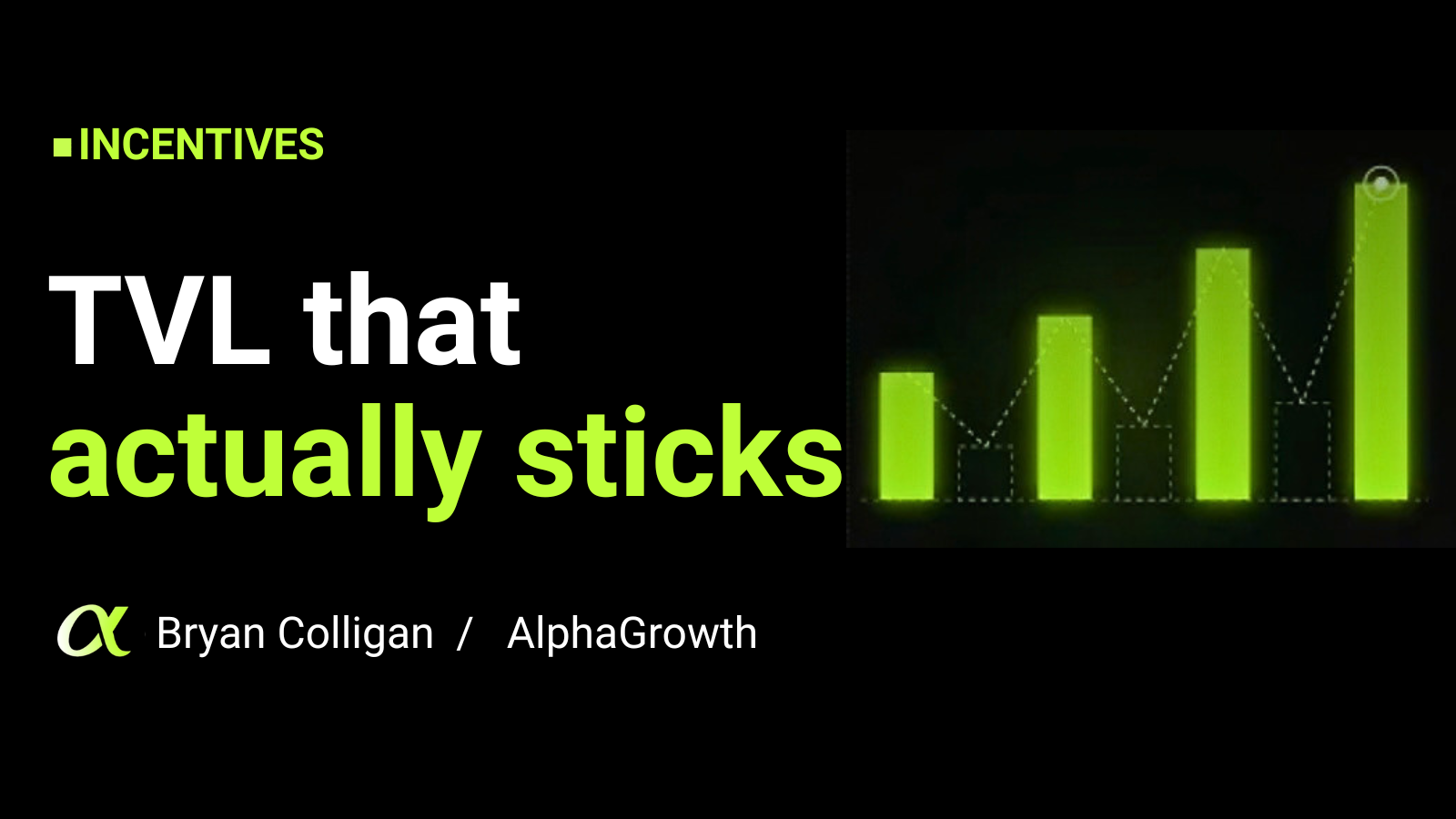
High TVL is easy to buy, but sticky TVL is much harder to build.
A new DeFi protocol or chain can launch with a huge APR, attract millions in deposits, and look successful within days.
Then the incentives stop, the capital leaves, and the TVL falls.
This is one of the most common mistakes in DeFi growth: treating incentives as a permanent source of demand instead of using them as a tool to learn what users actually want.
TVL is not the goal
Incentives can create TVL quickly, but they cannot guarantee that the TVL stays.
If users are only there because they are being paid more than the risk is worth, they have little reason to stay when another protocol offers a better deal.
That creates mercenary capital: capital that moves from one opportunity to another based on where the best incentives are available.
The problem is not that these users leave; the problem is building a growth strategy that depends on them staying.
AlphaGrowth has written extensively about this problem and how protocols can make capital more durable. Making Capital Sticky: How to Stop Mercenary Capital in DeFi
Use incentives as a test
A better way to think about incentives is to use them to test demand rather than assume they will create permanent demand.
Run a campaign, measure what happens, reduce or stop the incentives, and then see how much capital remains.
This tells you something a permanent incentive program cannot: whether users actually value the product.
One approach is to run incentives for one or two weeks, pause them for one or two weeks, and compare the results.
If TVL survives the pause, you have evidence of organic demand, while if it disappears immediately, you have learned something important about what was driving the deposits.
Don't pay everyone
Another common mistake is targeting the entire market, which may sound attractive but usually means spending money on users who are unlikely to become long-term customers.
Suppose you want to attract ETH liquidity. You don't need to give incentives to everyone in crypto; you need to understand the people who already hold ETH.
- What else do they hold?
- Where do they currently deploy their capital?
- What products do they use?
- What would make them move some of that capital to your protocol?
The better you understand the cohort, the less money you need to spend reaching it.
Think like a coupon, not a salary
A useful analogy is a supermarket sample: a free sample gets you to try something, but it is not supposed to feed you forever.
DeFi incentives should work in a similar way. Use rewards to get users to try a product, and then give them a reason to stay.
That reason could be:
- Better execution
- Useful integrations
- Real yield
- Deeper liquidity
- Better capital efficiency
- Access to another product
- A strategy they cannot easily replicate elsewhere
The incentive gets attention, while the product creates retention.
Change the campaign, not just the APR
Running the same campaign indefinitely also creates another problem because users learn the game.
If the same pool offers the same reward every month, sophisticated capital can optimize around it.
- Instead, change the test
- Change the audience
- Change the product
- Change the incentive
- Change the channel
The goal is not to keep the APR high; the goal is to learn what creates durable activity.
Look beyond TVL
TVL tells you how much capital is sitting in a protocol, but it does not tell you why that capital is there.
Two protocols can have the same TVL and very different businesses.
One may have:
- Active borrowers
- Trading volume
- Fee revenue
- Repeat users
- Product integrations
The other may have capital sitting idle because the APR is temporarily attractive.
Those are not the same type of growth.
That is why incentive programs should be measured against what happens after the incentives.
Recent AlphaGrowth work on Compound illustrates the same principle: the important question was not only how much TVL the campaign generated, but how deposits behaved after incentives and how those deposits connected to actual product usage. Rebuilding Compound's Growth Engine on Arbitrum
Sometimes the product can create its own incentives
There is another way to create attractive returns: design products where user activity generates the yield.
For example, a liquidity position can earn trading fees, while market volatility can create trading activity and that trading activity can generate fees.
Fees can then create organic yield.
That is different from paying users directly from a token treasury because the first model depends on economic activity, while the second depends on continued emissions.
The goal is sticky TVL
The best incentive program is not necessarily the one that produces the biggest TVL spike; it is the one that teaches you something about the users, markets, and products that can support durable growth.
- Which users came?
- Which users stayed?
- Which markets worked?
- Which integrations mattered?
- What happened when rewards stopped?
Those answers are more valuable than another temporary TVL record.
Use incentives to create a test.
Use the product to create retention.
Measure what remains after the rewards are gone.
That is how you turn purchased TVL into durable growth.
Need help designing a TVL growth strategy? Talk to AlphaGrowth.
Related news
How to Get Institutional Liquidity into Your DeFi Protocol
What is the Token Sink and Why is it the Opposite of Selling
How to Launch a DeFi Ecosystem to a New Chain
