

What is the Token Sink and Why is it the Opposite of Selling
Creating a token is only the beginning. Once a token is live, the project needs to create reasons for people to hold, use, stake, lend, or provide liquidity with it. Without those forms of utility, token holders have relatively few choices: buy the token, hold it, or sell it.
This is why at AlphaGrowth we think about token sinks differently. Sink your token, don’t sell it.
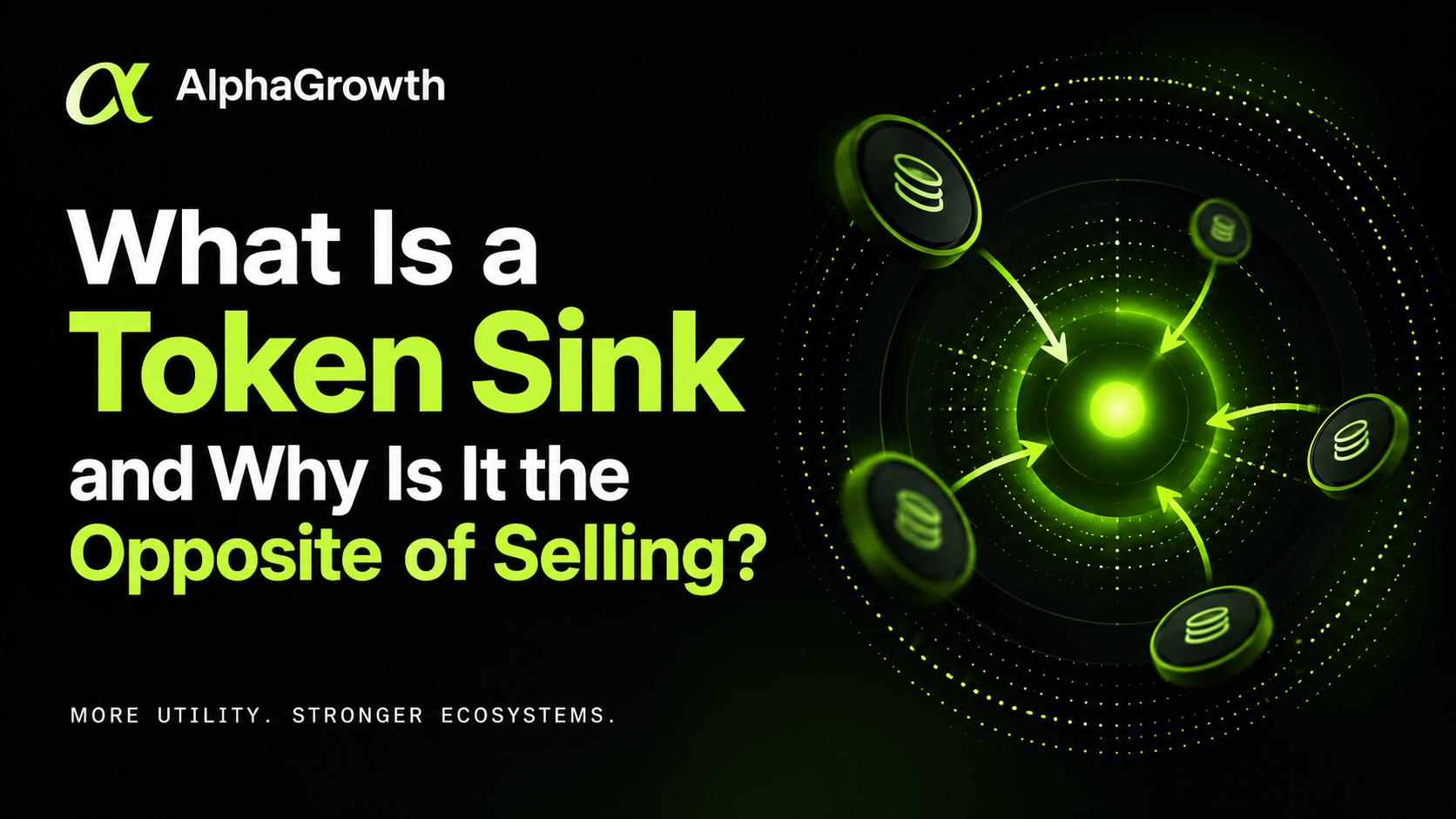
A token sink is any mechanism that takes tokens out of the freely available supply by giving holders a reason to put those tokens somewhere productive. Staking, lending, liquidity pools, and other DeFi applications can all create these sinks.
The goal is not simply to reduce the amount of tokens available to sell. The goal is to make the token more useful by creating productive places for capital to go.
A Token Has More Than One Use
When thinking about the opportunity cost of holding a token, there are several basic choices available to a holder. They can buy it, hold it, or sell it. In DeFi, there is another important option: putting the token to work.
One common example is providing liquidity. A user can pair a token with another asset and deposit both into a liquidity pool. In return, the liquidity provider can earn trading fees and, depending on the protocol, additional rewards.
This changes the role of the token. Instead of being something that is simply held or sold, it becomes an asset that can generate returns.
That additional utility is the foundation of a token sink.
Sushi and the Liquidity Sink
One example discussed in the transcript is Sushi.
In its early stages, Sushi created nine liquidity pools where its token could be paired with other assets, including USDC, Curve, and WBTC. These pools gave holders a reason to acquire Sushi and deposit it into liquidity positions rather than simply holding or selling it.
The important mechanism was not just that the token existed. The token had somewhere productive to go.
As the broader market and the assets paired with Sushi increased in value, the economics of those liquidity positions could become more attractive. Higher trading activity and higher rewards increased the incentive to keep Sushi inside those positions.
This created a feedback loop around utility: the more attractive the liquidity opportunity became, the more reason holders had to put their tokens into the liquidity system rather than leave them freely available to sell.
That is the core idea behind a token sink.
What Does It Mean to “Sink” a Token?
A token is effectively sunk when it is committed to a position that gives the holder a reason not to sell it immediately.
That can happen through:
- Staking
- Lending
- Liquidity pools
- Bonding mechanisms
- Perpetual markets
- Other DeFi positions
The important metric is therefore not only how many tokens have been issued. You also need to understand how many tokens are actively being used.
- How much supply is staked?
- How much remains continuously staked?
- How many tokens are locked in liquidity positions?
- How much is being used as lending collateral?
- How much is committed to other DeFi applications?
As more tokens move into productive positions, less of the circulating supply is immediately available for sale.
That does not guarantee that the token price will rise. Market conditions, emissions, demand, liquidity, and many other factors still matter. But from a token-design perspective, creating places where holders can productively deploy their tokens changes the supply dynamics around the asset.
This broader approach to creating token utility is closely connected to what AlphaGrowth calls token optionality and DeFi operations.
Staking: The First Token Sink
Staking is one of the most straightforward ways to create a token sink.
In a proof-of-stake system, token holders commit tokens to help secure and operate the network. In return, they receive rewards for participating. Ethereum's documentation provides an overview of how staking works and the role validators play in securing the network.
Staking is the baseline yield opportunity for a token because the holder is participating directly in the network rather than taking on a separate lending counterparty.
The economics are also relatively straightforward: when more people stake, the available staking rewards are distributed across more participants, which generally reduces the reward rate. When fewer people stake, the reward rate can increase.
This creates a simple reason for holders to keep their tokens committed to the network.
For a project with a credible staking narrative, staking can therefore be one of the first and most important token sinks to establish.
Lending Adds Another Layer of Utility
After staking, lending can provide another place for tokens to go.
Lending introduces additional risks because the token is being deployed through a lending market and involves counterparties, collateral, and the possibility of losses if the market is not properly managed.
That additional risk means lending opportunities generally need to offer a premium relative to lower-risk opportunities.
For the token itself, however, the important point is utility. A token that can be used as lending collateral or supplied to a lending market has another productive use beyond simply being held or sold.
This creates another destination for circulating supply.
Liquidity Pools Turn Tokens Into Market Infrastructure
Liquidity pools are another major token sink because they connect token ownership with market activity.
A liquidity pool combines two assets so users can trade between them. A token might be paired with USDC, ETH, or another major asset on the chain. When someone wants to trade from one asset into the other, the trade uses the liquidity available in the pool.
The amount of liquidity matters because thin liquidity can lead to significant slippage. When liquidity is deeper, larger trades can generally take place with less price impact.
For a token project, building liquidity therefore does more than create a place for tokens to sit. It helps create the market infrastructure needed for the token to be traded efficiently.
It can also create another source of yield for token holders through trading fees and, where applicable, liquidity incentives.
Not All Liquidity Positions Have the Same Risk
With a V2-style constant-product pool, the liquidity provider has a relatively simple decision: deposit the token into the pool or do not. Concentrated liquidity changes that decision.
In a V3-style model, liquidity providers choose a price range in which their liquidity will be active.
This can increase the potential efficiency and revenue of the position, but it also requires a more specific view of where the market is likely to trade.
That additional flexibility creates additional complexity and risk.
For token projects, this matters because a liquidity strategy should not be treated as a single product. Different market structures create different opportunities for token holders, and the appropriate strategy depends partly on the characteristics of the token itself.
Perpetual Markets Create Another Token Sink
Perpetual markets can provide another destination for token supply.
When a token has sufficient spot liquidity, it can become useful within a broader derivatives market.
That creates another place where the token can be deployed and another source of trading activity.
Perpetual markets can be particularly relevant for more volatile tokens because volatility creates demand for trading and leveraged exposure. At the same time, that volatility also means the associated risks are higher.
This is why token sinks should not be treated as interchangeable. The right mechanism depends on the token and the market around it.
Token Sinks Do Not Always Require Treasury Spending
One of the important points in the article is that creating a token sink does not necessarily require the treasury to spend tokens.
If a project already holds its own tokens, those tokens can potentially be deployed into staking, lending markets, or liquidity positions.
In some liquidity models, a project may even be able to provide liquidity without holding an equivalent amount of the paired asset, depending on the design of the liquidity position.
The cost changes when the project wants to attract other users.
That is where liquidity incentives become useful.
Instead of using incentives simply to distribute tokens, a project can use them to encourage users to place capital in specific markets and positions where that liquidity creates useful infrastructure for the ecosystem.
The distinction matters: the treasury does not have to pay simply to create a token sink; incentives can be used to make the sink attractive enough for other participants to use it.
Build Token Sinks in Layers
There is no single token sink that works for every project.
If a project has a strong staking narrative, staking should be established first.
If staking is not central to the token, liquidity can become the next major focus.
Once sufficient liquidity exists, the token can become more useful as collateral in lending markets.
From there, lending markets and liquidity positions can support more structured products and leverage.
As trading volume and volatility develop, perpetual markets and prediction markets can become additional destinations for the token.
The important idea is that these mechanisms can build on one another.
Liquidity enables markets. Markets create activity. Activity creates opportunities for additional financial products. Those products create more places for the token to be used.
That is how a token can move from being an asset people simply hold into an asset that supports an ecosystem.
Token Volatility Should Influence the Strategy
The characteristics of the token also matter.
A highly volatile token may be better suited to applications such as perpetual markets and certain liquidity strategies, where trading activity and volatility can create demand.
The same volatility can make the token less attractive for applications where stability and predictable collateral value are more important.
This means there is no universal order of operations for token sinks. The appropriate mix depends on the token's volatility, liquidity, existing demand, market structure, and the products available around it.
Even if the token's price falls significantly, the underlying question remains the same: where can this token go, and what useful activity can holders perform with it?
Sink Your Token, Don't Sell It
A healthy token economy needs more than issuance and distribution. It needs destinations.
Staking gives holders a reason to commit tokens to network security. Lending gives them another productive use. Liquidity pools turn tokens into market infrastructure. Perpetuals and other financial markets can create additional utility as the ecosystem matures.
Each mechanism takes tokens that could otherwise sit idle or be sold and gives them a productive role.
That is why token sinks are so important. The goal is not simply to reduce selling. The goal is to create enough utility that holding and using the token becomes more valuable than leaving it idle.
A token should not depend on constant new buyers to remain useful. It should have places to go.
Sink your token. Don't sell it.
Need help creating liquidity, token utility, and sustainable DeFi demand?
Talk to AlphaGrowth about your token growth strategy.
Related news
How to Get Institutional Liquidity into Your DeFi Protocol
How to Launch a DeFi Ecosystem to a New Chain

How to Grow TVL Without Overspending on Incentives
