

Where Wales Look: Getting Your Yield Found
Launching a DeFi protocol is only the beginning. Once your lending market, DEX, structured vault, or other yield product is live and generating organic yield, the next challenge is getting that opportunity in front of the users who are actively looking for it.
The strongest protocols do not simply publish their APR on their own website and wait for users to arrive; they distribute their yield, data, and strategy information across the places where capital already goes to research opportunities.
Start Where Users Already Look for Yield
One of the most important distribution channels is DeFiLlama’s Yields dashboard, where users can compare yield opportunities across protocols and chains.
Getting your protocol listed gives investors another place to discover your product, while also making your yield data part of a broader market dataset.
The same principle applies beyond a single aggregator. DeFi users research opportunities across a wide range of platforms, including VaultsFi, Merkle, Contango, 1inch, Morpheus, Euler, and Aave.
The goal is to make your protocol visible wherever your target users are already comparing assets, yields, strategies, and risk.
This is why distributing your data is not simply a marketing exercise. It creates a broader footprint around your protocol and puts your opportunity in front of people who are already demonstrating intent.
When someone is actively searching for yield, being present in that search is fundamentally different from trying to convince someone who was not looking for a DeFi opportunity in the first place.
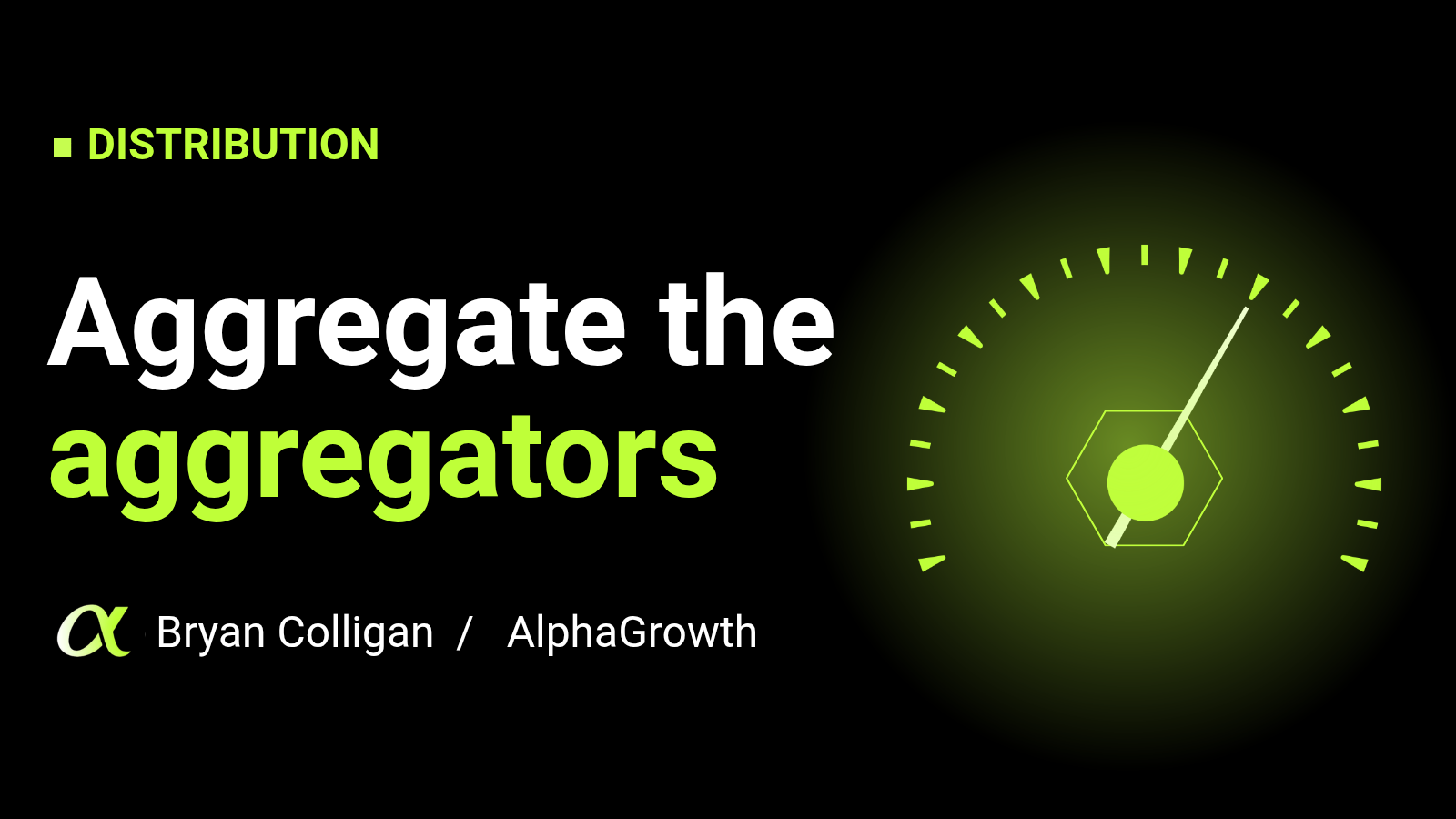
Aggregate the Aggregators
A useful way to think about DeFi distribution is to aggregate the aggregators. Your protocol should be listed across the major yield platforms, with accurate data, current APRs, correct links, and clean descriptions.
Every listing becomes another discovery point and another piece of the public record surrounding your protocol.
This also creates an opportunity for comparison. Once your protocol is consistently represented across major platforms, you can start building charts, social posts, and other content that shows where your strategy sits alongside established protocols.
Instead of simply telling the market that your yield is competitive, you can make that comparison visible.
Accuracy matters here. A protocol with outdated information, broken links, incomplete data, or inconsistent APR figures makes the entire growth funnel harder than it needs to be.
A pristine presence across the major aggregators gives users a clear path from discovery to research to deposit.
This broader approach to yield discovery is closely connected to the way AlphaGrowth’s DeFi analytics and yield tools look at protocol performance: capital follows opportunities that can be discovered, compared, and understood.
Where Do Whales Hunt?
Whales do not all discover opportunities in the same place. Some monitor wallets and copy trading activity through platforms such as DeBank, while others receive opportunities directly from their network or private trading communities.
One tactic mentioned in the transcript is placing a small amount of yield-bearing tokens or an incentive into other wallets as a way to introduce a new opportunity.
More broadly, however, distribution works best when multiple channels reinforce the same narrative.
Key opinion leaders on X can help build awareness around the strategy and create a community around the protocol's narrative.
Private Telegram trading groups can surface opportunities directly to active capital allocators.
Aggregators can capture users already searching for yield. Search engines and AI systems can help people discover the protocol while researching a particular strategy.
Each channel reaches a slightly different part of the capital market, which is why relying on a single source of traffic leaves growth on the table.
Make Your Protocol Easy for Search Engines and AI to Understand
Search is also changing. Users increasingly rely on AI chatbots for financial and investment research, which means protocols need to think beyond traditional search engine optimization.
The basic principle remains the same: make your information easy for machines and humans to find, understand, and verify.
Your website should clearly explain the strategy, the assets involved, the yield, the underlying mechanism, and the relevant risks. Your data should be structured and consistent across aggregators, while your public content should reinforce the same core information.
When users ask where they can find a particular type of yield, the protocols with clear, widely distributed, and consistently structured information have more opportunities to become part of that conversation.
This is another reason aggregation matters. The more places your protocol's accurate data appears, the more complete the information ecosystem around your project becomes.
Let Third Parties Help Validate the Yield
Your protocol should not be the only source telling the market that your yield is attractive.
Risk and credit systems such as Credora or Accountable can provide additional analysis around a strategy or yield product. Independent assessments can help users understand not only the headline return, but also the risk-adjusted characteristics behind it.
That distinction matters because sophisticated capital does not evaluate yield in isolation. A 20% APR means something very different depending on the asset being supplied, the duration of the position, the underlying strategy, the capacity available, and the risks involved.
Third-party validation adds another layer of credibility to the distribution process. Instead of asking users to rely entirely on the protocol's own claims, you give them additional information with which to evaluate the opportunity.
Understand the Whale's Internal Hurdle Rate
Every serious capital allocator has an internal hurdle rate. Before a whale or LP chooses your protocol over another opportunity, they are effectively asking a series of questions.
Which chain does the opportunity live on?
Is the yield high enough?
Which asset do I need to supply?
How long do I need to keep that asset deployed?
How much capacity is available before yield compression occurs?
These criteria determine whether the opportunity clears the allocator's internal hurdle rate. Your job is not simply to advertise a high APR; it is to make the entire opportunity understandable enough for a capital allocator to compare it against everything else available in the market.
That means distribution should communicate more than one number. Yield, asset, chain, duration, capacity, strategy, and risk all form part of the product.
The Front End Is Part of Your Distribution Strategy
Getting a whale to discover your protocol is only half the journey. Once they arrive at your website, the experience needs to reinforce the confidence that brought them there.
A strong yield opportunity can still lose capital if the front end feels insecure or difficult to navigate.
Wallet warnings, unclear transaction flows, broken links, poor design, or inconsistent information can immediately interrupt the journey from interest to deposit.
For a large LP, the website is part of the due diligence process.
If the experience feels polished, secure, and straightforward, it reinforces the quality of the underlying protocol. If the experience creates friction, it can undermine everything that happened before the user arrived.
The customer journey therefore needs to be designed around the capital allocator, from the first impression through wallet connection, strategy selection, deposit, and ongoing monitoring.
Distribution Turns Yield Into a Growth Engine
Organic yield does not automatically create organic TVL. The opportunity has to be discoverable.
The strongest distribution strategy combines several layers:
- List your protocol across major yield aggregators.
- Keep every listing accurate, current, and easy to understand.
- Build content around your strategy and competitive positioning.
- Use KOLs and communities to amplify your narrative.
- Make your website and data readable by search engines and AI systems.
- Use third-party risk or credit analysis where appropriate.
- Communicate the factors that matter to whales and institutional LPs.
- Make the deposit experience secure, clear, and frictionless.
The goal is to create a system where discovery compounds.
A user finds your protocol on an aggregator, researches it through search or an AI chatbot, sees supporting content and third-party information, compares the opportunity with competitors, and ultimately reaches a clean front end where depositing capital feels straightforward.
That is how you turn yield into distribution, and distribution into TVL.
Final Thought
DeFi capital is already searching for yield. Your job is to make sure your protocol is present wherever that search happens.
Do not just create a great yield opportunity. Distribute it.
The more accurately and consistently your protocol appears across aggregators, communities, search engines, AI systems, and your own website, the more opportunities you create for organic capital to discover what you have built.
When the yield is real, the data is clear, the opportunity is easy to compare, and the user journey is smooth, distribution becomes a growth engine rather than a final step after the product is built.
Need help turning your DeFi yield into sustainable TVL growth? Talk to AlphaGrowth about your protocol's distribution and growth strategy.
Related news
Fund the Founder, Not Just a Code
How to Get Institutional Liquidity into Your DeFi Protocol
What is the Token Sink and Why is it the Opposite of Selling
