Borrowing Against Locked or Vesting Tokens
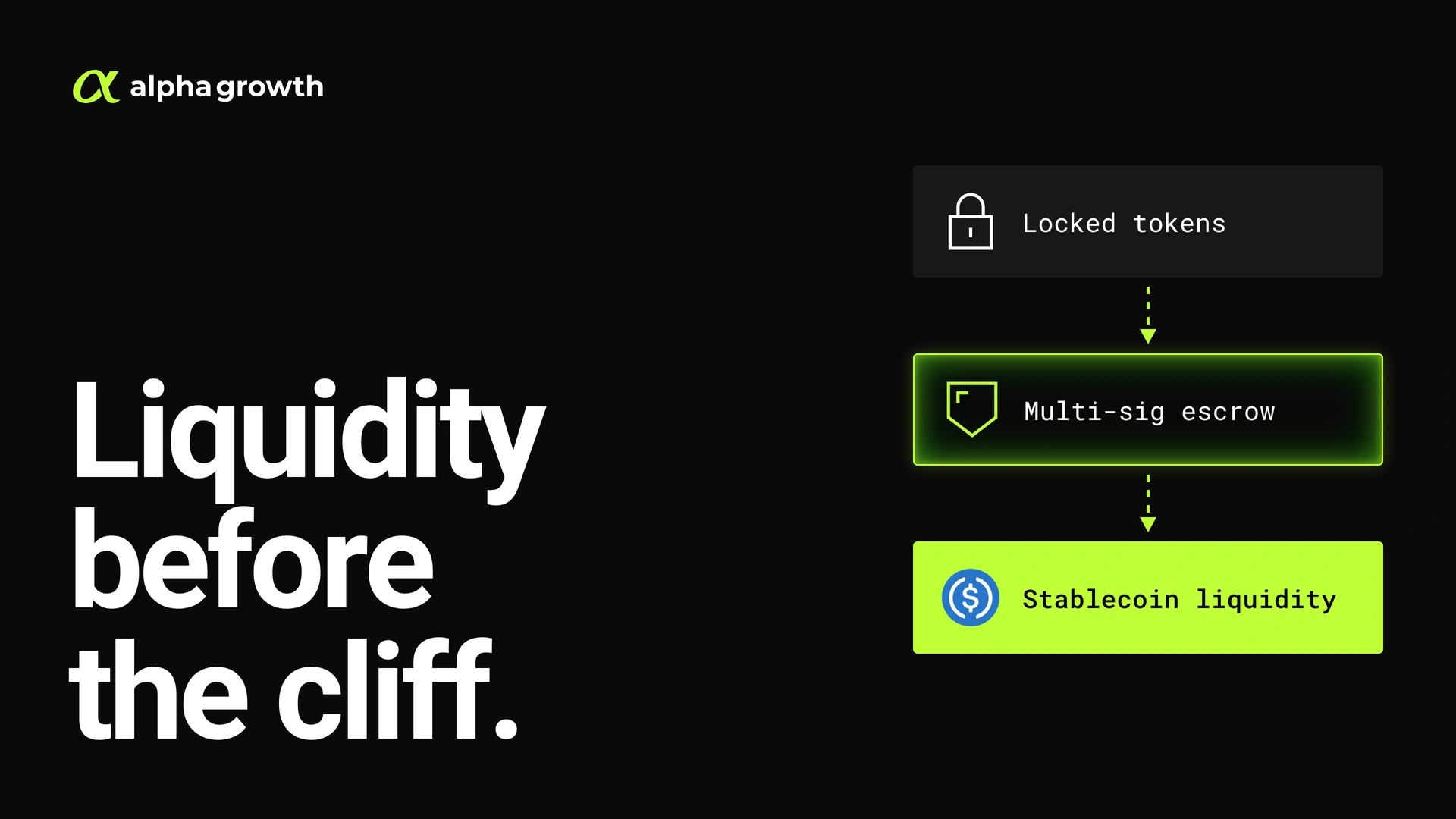
Founders and early core team members can get a loan against locked or vesting tokens through specialized off-chain institutional credit facilities. While public DeFi protocols reject illiquid and timelocked collateral, institutional private lenders underwrite unvested allocations based on protocol revenue, fully diluted valuation (FDV), and unlock schedules offering non-dilutive liquidity at conservative Loan-to-Value (LTV) ratios between 15% and 35% without requiring open-market token sales.
The Paper-Rich, Cash-Poor Founder Paradox
In Web3, personal liquidity rarely mirrors balance-sheet equity. Founders, seed contributors, and core developers frequently hold millions of dollars in project tokens that are legally or programmatically restricted under multi-year vesting agreements or cliffs.
When cash-flow needs arise - funding secondary operations, paying tax liabilities on prior capital events, or covering personal runway founders face severe friction:
Selling is contractually or technically impossible: Tokens locked inside smart contracts cannot be moved to exchange wallets.
Secondary market sales destroy project optics: Even when OTC secondary blocks are theoretically negotiable, selling equity before a major milestone signals a lack of conviction to investors and community members.
Public DeFi platforms reject the collateral: Depositing assets into automated money markets requires liquid, transferable ERC-20 or native tokens.
Borrowing against the future stream of vesting tokens bridges this gap, allowing founders to monetize unvested equity without selling a single token.
Why Standard DeFi Protocols Reject Illiquid Collateral
Automated lending markets like Aave, Compound, and Morpho rely on one foundational assumption: instant, permissionless collateral liquidation.
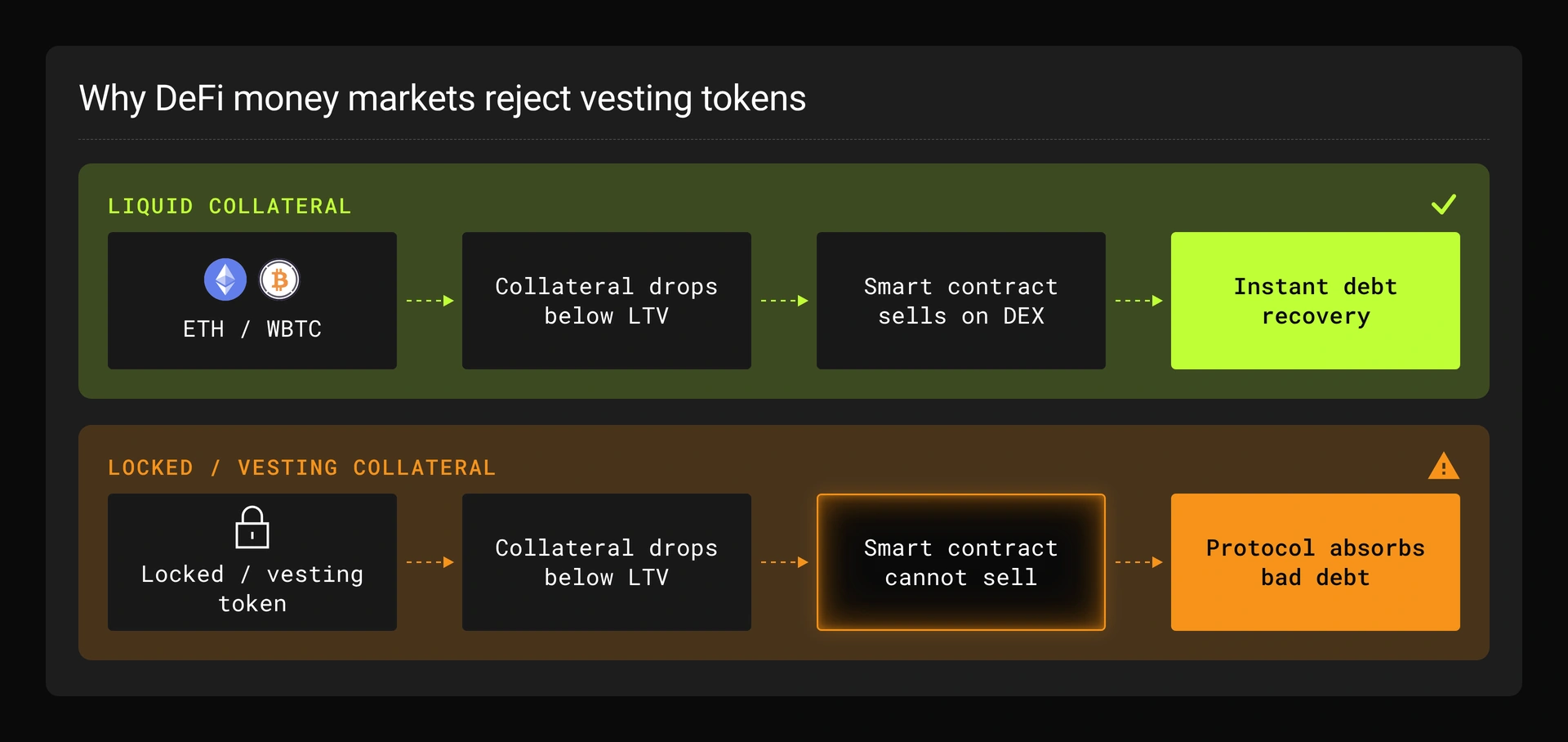
As detailed in Aave's Liquidation & Risk Parameters, smart contracts manage solvency by programmatically auctioning collateral on decentralized exchanges the moment a position crosses the liquidation threshold.
Because automated protocols cannot seize and liquidate assets locked inside a timelock contract, they cannot manage solvency risk programmatically. If a token's price crashes while locked, a public pool has no mechanism to recover its stablecoin loan.
Consequently, underwriting locked or vesting collateral requires human diligence, institutional balance sheets, and custom legal architecture.
How Institutional Lenders Underwrite Vesting Schedules
Institutional private credit desks and specialized liquidity operators do not look merely at current spot token prices. They treat a vesting token loan as an asset-backed corporate debt facility, evaluating five structural metrics:
1. Fully Diluted Valuation (FDV) vs. Circulating Float
Lenders analyze the gap between circulating market capitalization and FDV. A project with only 5% of its tokens in circulation faces massive future dilution as team and investor tranches unlock, which demands a heavier collateral haircut than an asset with 60% of its supply already circulating.
2. Emission Velocity & Upcoming Cliffs
Underwriters map the entire ecosystem's unlock schedule. If an upcoming investor cliff will double the circulating supply in three months, the credit desk will price in the expected sell pressure and adjust loan duration or LTV accordingly.
3. Protocol Cash Flow & Runway
Lenders evaluate the underlying business. Does the protocol generate organic fee revenue? Does the treasury have at least 24 to 36 months of fiat runway to survive a prolonged bear market? A cash-flow-positive protocol provides confidence that the project will survive well beyond the loan maturity date.
4. Secondary Market Depth & Liquidity Sinks
A token with $500M FDV but only $200K in daily decentralized exchange depth cannot absorb liquidation risk. Credit desks assess how baseline borrow rates and market liquidity behave across Alphagrowth MCP and review existing token sinks - such as staking mechanisms, protocol fee capture, and liquidity pools - to verify whether the market can support orderly OTC sales if liquidation becomes unavoidable.
5. Counterparty Standing & Founder DNA
The borrower’s history matters. Lenders assess whether the founding team has executed successfully in past cycles, their legal jurisdiction, and their commitment to long-term governance continuity.
Legal Assignment vs. Programmatic Escrow
Securing a credit line against unvested assets requires legal enforceability and verifiable technical custody. Institutional transactions merge both layers:
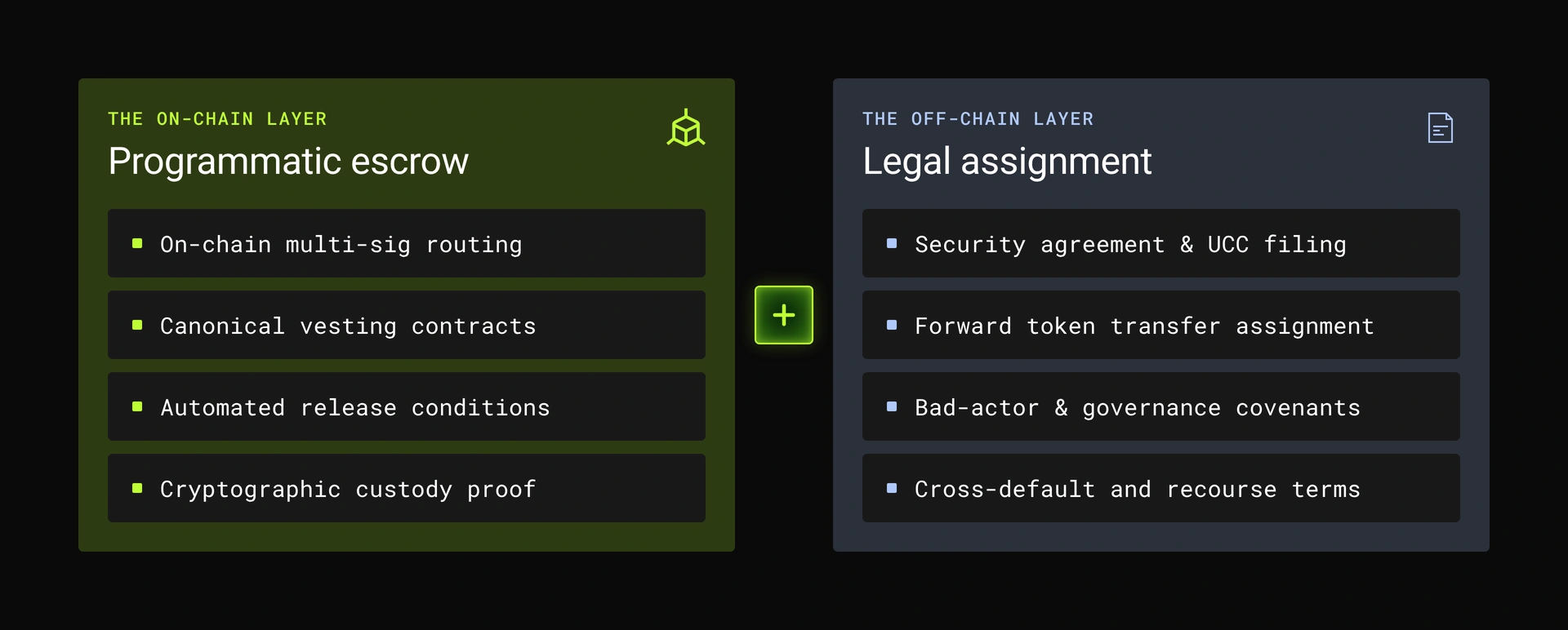
1. Programmatic Escrow (The On-Chain Layer)
Tokens are governed by smart contracts deployed via established standards, such as the OpenZeppelin VestingWallet standard.
To collateralize the loan, the contract's beneficiary address is set or transferred to a segregated institutional multi-sig vault, built on frameworks like Safe's Smart Account Architecture, co-signed by the borrower and the lender.
As tokens unlock linearly or at cliff milestones, the contract routes newly vested tokens through predefined splits: a portion settles outstanding loan interest or principal, while the remainder is released directly to the borrower.
2. Legal Assignment (The Off-Chain Layer)
Because smart contracts alone cannot capture real-world legal obligations, institutional facilities operate under formal credit agreements:
Collateral Pledge & Security Agreement: Grants the lender a first-priority security interest in the borrower’s right to receive future token distributions.
UCC-1 Financing Statement: Filed in the borrower’s relevant jurisdiction to establish a public legal claim over the digital asset proceeds.
Negative Covenants: The borrower agrees to covenants prohibiting them from re-hypothecating the underlying allocation or altering protocol governance to dilute the pledged share.
Conservative LTV Modeling: Why 15%–35% Protects the Founder
When founders see blue-chip crypto loans offering 60%–70% LTV, a 15% to 35% LTV on unvested tokens can initially look restrictive. In practice, conservative LTVs are designed to protect the founder from forfeiture.
Collateral Category | Typical LTV | Volatility Buffer (Drop Required for Margin Call) |
|---|---|---|
Liquid Blue Chips (BTC/ETH) | 50% – 70% | 20% – 30% drawdown |
Liquid Altcoins (Top 50) | 35% – 45% | 35% – 45% drawdown |
Locked / Vesting Native Tokens | 15% – 35% | 55% – 75% drawdown |
The Value of the Volatility Buffer
Cryptocurrency markets routinely experience 40%–60% drawdowns during cyclical corrections. If an unvested token loan originated at 60% LTV, a routine market dip would trigger immediate distress.
By originating at 25% LTV against the token’s current market value:
The token price must drop by more than 55% to 65% before a margin call threshold is reached.
If a margin threshold is breached, institutional agreements provide contractually defined margin call grace periods (24 to 72 hours).
During this window, the founder can pledge alternative collateral (liquid stables, secondary tokens) or pay down a portion of the debt balance, avoiding liquidation during temporary market dislocations.
The Alphagrowth Framework: Structuring Private Credit Facilities
Navigating institutional lending against illiquid token positions requires operational alignment between token design, market liquidity, and institutional capital desks.
Alphagrowth acts as an institutional operator across the full capital lifecycle:
Direct Private Credit Structuring: Structuring bespoke credit facilities for founders, funds, and foundations, matching locked collateral with lenders operating through qualified custody.
Token Sink & Liquidity Optimization: Designing productive token sinks—such as staking, on-chain lending integrations, and custom structured product vaults—that deepen market liquidity and make underlying assets more defensible to credit underwriters.
Ecosystem Growth Alignment: For projects seeking broader ecosystem expansion, AlphaGrowth’s TVL Growth practice structures liquidity bootstrapping programs and institutional LP partnerships that expand protocol adoption without depleting treasury reserves.
Alphagrowth grows TVL for protocols and chains, and helps large token holders borrow against or earn yield on their holdings.
Need to unlock liquidity against your locked or unvested token allocation?
FAQ: Loans Against Locked and Vesting Tokens
Can I get a loan against locked or vesting crypto tokens?
Yes. While retail DeFi protocols cannot accept illiquid assets, specialized institutional private credit desks and liquidity operators can structure custom loans using locked or vesting tokens as collateral.
Why don't standard DeFi platforms like Aave accept unvested tokens?
DeFi lending protocols rely on automated smart contracts that immediately liquidate collateral on decentralized exchanges when an LTV threshold is breached. Because locked or vesting tokens cannot be transferred or sold until their lockup expires, smart contracts cannot enforce liquidations, exposing the protocol to bad debt.
What LTV can I expect when borrowing against unvested tokens?
Loans against locked or vesting tokens typically carry conservative Loan-to-Value (LTV) ratios between 15% and 35%. This conservative buffer protects the borrower, requiring a 50% to 75% market drop before triggering a margin call.
How is collateral secured during a vesting token loan?
Collateral is secured through a combination of programmatic escrow (such as multi-sig vaults or assigning the beneficiary on a vesting contract) and formal legal agreements (security agreements and UCC filings) that assign the economic rights of the vesting stream to the lender.
What happens if the token price crashes during the vesting period?
If market drawdown pushes the loan beyond agreed LTV thresholds, the facility triggers a formal margin call. Unlike on-chain protocols that liquidate instantaneously, institutional credit agreements provide a 24- to 72-hour grace period, giving the borrower time to deposit supplementary collateral or pay down principal.
How do token unlocks affect loan repayment?
Repayment structures are routinely mapped directly to the vesting schedule. As token tranches unlock over time, agreed percentages of the newly liquid tokens can be sold in orderly OTC blocks or transferred to service interest and principal obligations.
Want the latest data about stablecoins?
Try our free MCPRelated news
MON unlocks are coming: how to keep earning on your MON

AI Agents vs Vault Curators: Who Should Manage Your Yield?